Showing posts with label 3 Stars. Show all posts

Friday, October 14, 2011

Who is the Black Panther?

x-posted with Narrative Review

Title: Black Panther: Who is the Black Panther?
Author: Reginald Hudlin & John Romita, Jr.


Inspired by the decolonization of Africa, Stan Lee and Jack Kirby introduced a new character into the pages of The Fantastic Four in July of 1966. The first prominent black superhero to appear in American comics, the Black Panther was really T'Challa, a costumed adventurer who ruled the fictitious African state of Wakanda. Since his introduction, Black Panther has attracted a solid fan base, but he has been most successful as a supporting character. Whether this is because comic book fans are reluctant to pick up a book that stars an African character is a subject much debated by comic creators and fans alike.

Reginald Hudlin's Who is the Black Panther? (2006) is an attempt to both streamline the character's storyline and to make him a more prominent figure in Marvel's publishing line. In the back of the collection, Marvel has provided readers with what I assume is Hudlin's pitch for the series. Here, Hudlin establishes that he wants his run to be an iconic version of the character--something that Marvel could base a film franchise upon. (In 2009, the series would serve as the basis for a cartoon on NET). No doubt, this was a smart move given Marvel's recent forays into film. In his attempt to define the character for his editors, Hudlin writes:
The Black Panther is the Black Captain America. He's the embodiment of the ideals of a people. As Americans, we feel good when we read Captain America because he reminds us of the potential of how good American can be, if, of course, we have the conviction to live by the principles the country was founded on. As a black person, the Black Panther should represent the fulfillment of the potential of the Motherland.
For the most part, Hudlin succeeds in writing the "movie version" of the character. Who is the Black Panther? has a strong narrative thrust that would play well on the big screen. Of course, Hudlin is assisted admirably by veteran comic book artist John Romita, Jr., who uses wide panels to reproduce the experience of cinema. In the first chapter of the collection, the pair effectively defines not only who the Black Panther is, but what makes the nation of Wakanda so significant. Unlike the rest of Africa, Wakanda is a technologically advanced society that has never been conquered by another nation. They have always remained free of colonial rule. Hudlin's plot hinges on whether or not that will remain the case.

At times, Hudlin and Romita are capable of subtlety. When the United States plans an invasion of Wakanda and the assassination of T'Challa, we can see a sense of conflict on the face of Secretary of State Ms. Reese (an obvious surrogate for Condoleezza Rice). She is simultaneously disgusted by a racist U. S. military culture, proud of Wakanda's accomplishments, and perhaps, willing to attack the nation simply to prove her patriotic bona fides. Similarly, Hudlin is also willing to showcase the xenophobia of the Wakandas whose technological superiority manifests itself in arrogance and disdain for the outside world.

However, more often than not Hudlin goes too far in his effort to establish T'Challa and Wakanda as real "bad@asses" (his word, not mine). Instead of simply invading Wakanda, the U. S. covertly funds a crack team of super villain mercenaries. Super villains are a natural fit for any superhero series, but Hudlin goes too far by making the villains representative of Africa's colonizers: Belgium, Britain, France, and the United States. This is heavy handed and in the case of the U. S., not entirely accurate historically . Even here, Hudlin doesn't leave well enough alone and also attempts to indict Christianity's role in colonization of Africa. Thus, Hudlin creates a Church conspiracy (shades of The Da Vinci Code) in order to indict Christianity's troubling past in Africa. In doing so, he makes the British villain, the Black Knight, the Church's sworn servant. Readers are conveniently supposed to forget that England has been a Protestant nation since the 16th century. And then, at the end, there are the zombie cyborg marines whom T'Challa scares off with a few words. Is that too much? I suppose that depends on your sensibilities.

All and all, Hudlin's Black Panther is an engaging read, but at times its politics are--if not black and white--capable of only four colors.

Saturday, November 17, 2007

This Week in Comics #1: Batman and the Outsiders #1

This week begins a new quasi-weekly feature. Much like Chris's Invincible Super-Blog and The Absorbascon I will be giving weekly reviews of the comics that I read for the week. Luckily for my wallet and my typing fingers, my usual Wednesday stack is something like .5 comics per week and the most I think that I've ever bought was something like six issues, so the reviews will be relatively light and again, quasi-weekly.

This week's purchase is DC Comics's Batman and the Outsiders #1 and comes to us from the creative mind of Chuck Dixon and the talented hands of Julian Lopez. Overall, I found this first issue to be a promising start, but a little slow. Clearly, this first storyline will go for five or six issues when it could probably be parred down to three and be more enjoyable.

The series brings back a title from the mid-1980s. The concept for the original series was that Batman had started his own super-team after his own relationship with the Justice League became strained. While the series was popular for awhile, eventually sales dropped and the title was canceled. Having read a few issues of the original, it's hard to say why the series was ever popular. While there were a few interesting characters on the team, most of them were more super-lame, then superheroes. Take for instance one of the series's more "popular" characters, Halo; Halo's powers literally consist of being schizophrenic and looking like a refugee from an Abba video. The most recent reiteration of the team previous to this new series, ended only a few months ago. This title, scripted by Judd Winnick, presented the Outsiders more as a grown up version of Teen Titans, with a good deal of the team's membership coming from that title. Think Slackers meets Mission Impossible and you'll have a good idea of what was going on.

Thankfully, this new Batman and the Outsiders is taking a much different direction. The current series is un-acknowledgedly built on the back of Wildstorm's The Authority, a titlethat featured characters remarkably like the original Justice League who pretty much extort the world's governments to be peaceful and socialistic. It was in short, a leftist's wet dream. During The Authority's original run, DC (Wildstorm's parent company) found the title's radical politics too much to bear and began censoring the title until it lost much of its audience. However, since the appearance of The Authority, DC has consistently tried to build an Authority-lite team into its mainstream books. Books which have tried the Authority-lite formula have had a hard time finding their voice. Playing within the confines of the DC Universe (DCU), these team books could never be as radical as their Wildstorm equivalents and thus the aesthetic and the supposed "bad-assness" of the series always felt hackneyed.

Luckily, Batman and the Outsiders manages to find the proper balance between the bright spandex view of reality that is the DCU and the proactive stance that was necessary for a book like The Authority to work. Chuck Dixon has managed to find the right scale. The Outsiders cannot blackmail the Russian government to relent in persecuting the Chechnyan people like The Authority, and luckily Dixon does not give us the DCU equivalent (as of yet) of having the Outsiders liberate one of DCU's many fictional third world banana republics or Eastern bloc countries. Instead, the villain here is a corporation which seems to be engaged in some highly suspect research and so Batman sends his newly formed team to investigate. It's not something the JLA would normally do as it involves some espionage and undercover work, but its also not on the same scale as The Authority and so the story does not become ridiculous or parodic. It's not too big and it's not too small. Dixon has managed to find the right niche for this incarnation of The Outsiders.

While much my interest in the book has come from Dixon's ability to blend Authority style action into the DCU mainstream, most of the discussion of this book has been focused on the book's supposed homophobia, and I think it's only fair to mention this in my own review. Feminist comics bloggers like Kalinara have criticized the first issue for its disrespect of lesbians and even relatively apolitical bloggers like Chris Sims have complained that the series seems to have a moment where things become derogatory.

Most of this controversy stems from the fact that Chuck Dixon is one of the few openly right wing comic books who has chided writers for including openly gay characters in their work. Now, most of Dixon's complaints stem from his discomfort with sexuality of any sort being openly stated in comics, but it is clear and clearly lamentable that there does seem to be a double standard at work. Much like the military's "Don't Ask, Don't Tell" policy, Dixon's rules about representation seem to allow for open heterosexuality without it being indecent, but homosexuality always seems to be sexual or sensual and thus a big comic no-no. This does present Dixon with a noticeable problem in writing The Outsiders because he's inheriting the title from Judd Winnick, an author has had gay-rights themed issues in other titles and has made The Outsiders at times, sexually explicit. As such, Dixon inherits a book that used to be everything he hates: it was sexually explicit (although not graphic) and it had two lesbian characters.

Now the immediate controversy at hand stems from Batman, supposedly unintentionally, goading his lesbian teammate Thunder into outing herself and her girlfriend/teammate Grace. Thunder is enraged when Batman refers to Thunder and Grace's "special" relationship. According to Batman, he only meant to say that they were good friends. Thunder is the one who misunderstands and believes that he is speaking euphemistically and thus, degradingly. Much of the criticism from Kalinara and Sims has to do whether or not Batman would know about their lesbian relationship and whether or not Batman would ever speak like this. I've come to understand that this level of nuanced true-to-character stuff will vary from writer to writer, particularly in an age when DC editing is as bad as it is. Would Batman would refer to someone as being "special" friends without understanding the implication of the word "special"? One would think that he would be quite sensitive to these type of implication given the fact that he's spent most of his adult life as a single man living with young boys and a domineering, elderly gentlemen; but I cannot say for certain whether or not Batman does know about what the word "special" implied beyond what I read in the text. Dixon's version of the character seems not to know what he was doing, even if as readers we think thinks this makes Batman an idiot and not the world's greatest detective.

Kalinara particularly criticizes Dixon for Thunder's reaction to Batman's usage of the word "special", which admittedly, does seem so over the top that it paints her as irrational. There seems to be more truth to this critique then whether or not Dixon is being true to Batman's character. Thunder does seem to be unhinged at Batman's remark, even when you do consider that she is rightfully upset that Batman is trying to fire her from the team.

However, is this as homophobic as Kalinara makes it seem? I don't think so. Or at least, I'm reluctant to say from this one issue, or rather from this one scene which consists of little more than a few panels. I'm willing to wait and see what happens over the next few issues to see whether or not Dixon's ideological biases (which I clearly do not agree with) override his ability to tell a good story. What I can say for now is that the scene is awkward and it is a blemish on what is an otherwise good story. Whether or not it is awkward because it suffers from Dixon foisting his beliefs onto the story, I am at this point, undecided. In the past I have seen Dixon portray right wingers as political nuts and I've seen him write what I thought was one of the best girl-positive series in a long time, Batgirl: Year One. I have high hopes for this series; I think it might be able to make some minor advances in the superhero genre, at least in terms of the DC mainstream. That being said, I take the critiques of Kalinara with more than a grain and salt and I do have my reservations.


Addendum: Boy, was I wrong about Dixon. As later issues showed, Dixon took a kind of sleazy interest in the sex lives of his lesbian characters. Rather than succumb to homophobia, Dixon's Outsiders read like a hastily executed frat-boy wet dream.

Friday, September 8, 2006

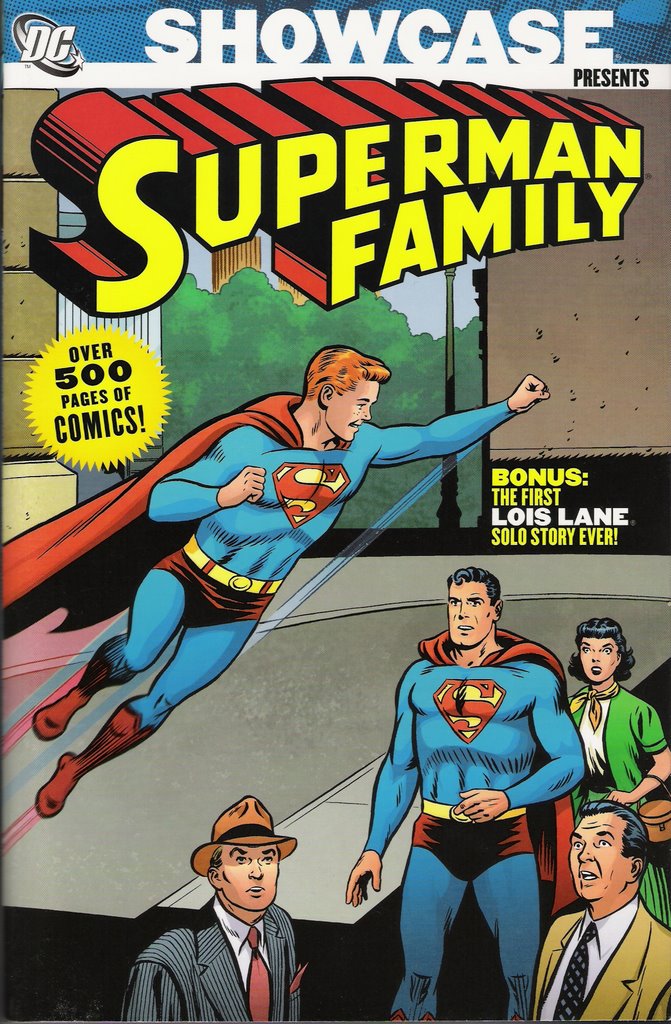
Showcase Presents: Superman Family


Yes, once upon a time comic books were so popular with children (as opposed to weird adults) that not only did Superman have two series (Action Comics & Superman), but even his supporting cast members like Jimmy Olsen and Lois Lane could support their own series. Showcase Presents: Superman Family vol. 1 celebrates those halcyon days of comics publication. Like other titles in the Showcase Presents series, Superman Family reprints five hundred pages of DC Silver Age adventures. Superman Family essentially contains the first twenty-two issues of Superman’s Pal, Jimmy Olsen, but because it includes Lois Lane’s first solo story it had to be renamed. Presumably future volumes will not only contain stories from the pages of Jimmy Olsen, but will also publish reprints of Superman’s Girl-Friend: Lois Lane, a title that premiered later.

The inclusion of the Lois Lane material can only be a good thing, as I really dig the I Love Lucky romantic comedy zaniness of the early issues and find the “feminism” of the later issues to be curiously entertaining if not inspiring. The inclusion of the Lois Lane material will also probably improve the overall quality of the volume, because the Jimmy Olsen issues tend to be less successful than what I read in Showcase Presents: Superman.

While the Superman material tends to be formulaic, the stories do tend to show more cleverness and play within that formula than those in Jimmy Olsen. While I like Jimmy Olsen in theory because he’s the most any of us can be by being a friend of the gods, in practice reading about the friend of the gods can get quite boring. In general, Jimmy discovers the plan of some local mobster who must, as union rules dictate, have some moniker like “Lucky” or “Legs” in quotes. Jimmy tries to solve the crime or get the scoop on his own or because he wants to help Superman, but inevitably gets into trouble and either has to have Superman help him secretly or has to ask for help directly by using his signal watch. I’m about half way done with the volume now and it only seems to be getting more and more formulaic. Although to be fair, it might only seem that way because the formula becomes more and more apparent as I read on.

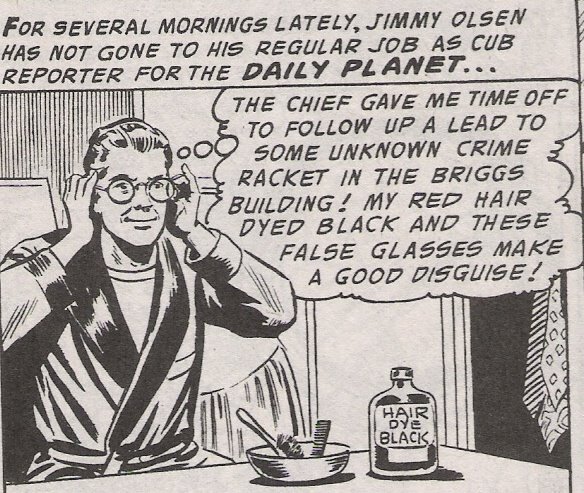
However, there isone issue that isjust simply so great that I have to praise it. Usually, there is nothing more boring than having a comic book story (or fan) explain how a generic convention is actually possible. The issue of Jimmy Olsen that I adore naturalizes the convention that glasses are an adequate disguise without such an explanation. In the issue Jimmy Olsen notices “Loot” Logan (see I’m not lying about the “names”) and other criminals are going to the Briggs Building. Jimmy decides that he will disguise himself as Dick Hunter, Elevator Boy and get the scoop. Unfortunately, Jimmy gets an accidental knock to his noggin and as what tends to happen when one gets hit in the head, suffers amnesia. Jimmy, still in disguise, mistakes himself as Dick Hunter and goes about his day. At one point he sees an advertisement for The Daily Planet that informs readers that Jimmy Olsen is on staff and is Superman’s Pal. Jimmy, as Dick Hunter, envies Jimmy Olsen’s relationship with Superman not realizing that he really is Superman’s most special buddy. Perfect!! Jimmy, even as Dick, is still Jimmy and so he manages to stumble upon the criminals’ scheme (they’re running a crime school), gets in trouble, and after being told by the criminals that he is Jimmy Olsen, has to signal Superman for help.

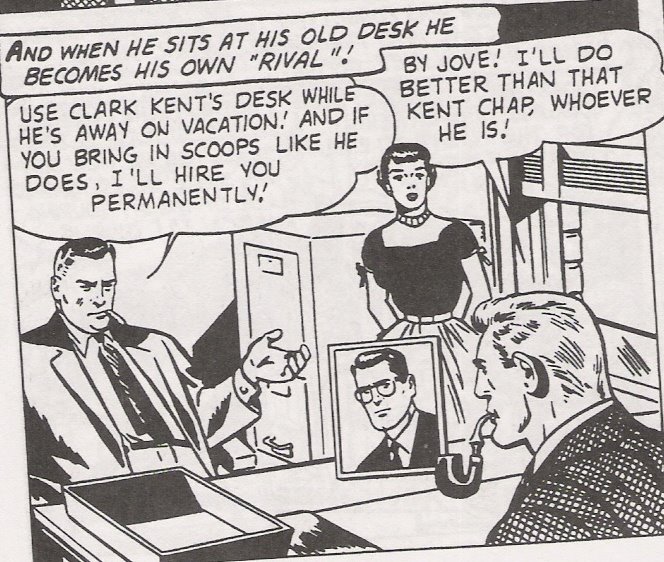
Even though I have some affection for the story, it too proves to be formulaic. Not only that, it’s also pilfered from another Superman comic. In Showcase Presents: Superman vol. 1 my favorite story was one where Superman gets amnesia and disguises himself as Englishman Clarence Kelvin. Kelvin takes a temporary job at The Daily Planet, filling in for Clark Kent while heis on vacation. Starring at a photo of Clark Kent on his desk (why Clark keeps a headshot of himself on his desk is beyond me), Superman does not recognize himself. Olsen’s plot reenacts the entire device, only without the clever twist. At the end of the Sueprman story, Lois feels gratified that she’s finally figured out that Superman is really Clarence Kelvin. Superman, realizing that he has nothing to fear, merely shreds the disguise and says that Lois has got him, but now she’ll have to try and figure out his new identity. In contrast, Jimmy gets knocked on the head again, regaining his memories as Olsen, but cannot remember the adventure he has just had as Dick Hunter. While the last panel does produce pathos, it’s just not as clever.

Future posts if things get better.

Thursday, June 29, 2006

Superman Returns


It probably will not come as a surprise that I saw Superman Returns on opening day. While there are numerous filmic arguments that I would like to make (first among them is how the film is a literal re-scripting of the first film from 1978), none of them seem intellectually honest at the moment. For what has always brought me to Superman has been my heart.

Because of this, I will tell everyone my favorite part of the movie and why it is scenes like this that draw me to the Man of Steel and to the superhero genre in general. Early in the film, we see Superman sitting on Martha Kent's couch in Smallville watching television. He has been away for five years, exploring space and as such has lost touch with the events of Earth. Watching TV, he flicks through news report after news report. The expression on his face says it all. When Superman watches tragedy after tragedy on the news he does not see it as we see it and Brandon Routh does an excellent job of conveying this fact. For when I watch the news and hear of tragedy or hardship I either watch passively, viewing the event as something very removed from my life, or watch it sadly, knowing that there is not much that I can do to ameliorate the situation. When Superman watches the news, a flash of anger crosses his face but it is tempered with determination. For Superman knows that he is capable of leaping tall buildings in a single bound, that he is faster than a speeding bullet, and that he is more powerful than a locomotive. In short, Superman knows that he can do something about it.

A scene like this is also in a film of a much lower caliber, Teenage Mutant Turtles. In that film the vigilante Casey Jones (for those of you who don’t remember (and consider yourself lucky) Jones is a cross between Travis Bickle and Jason), watches the news and decides that he will fight crime. But Jones watches the news differently than Superman. Jones watches the news like it is particularly violent pornography and it cannot help but to inspire him to commit equally violent actions. Jones wants to hurt the people he's feed up with. It's not about decency; it's all about revenge and violence. However, what makes me like Superman more than all other superheroes is that Superman stands for as Perry White says in this film, "Truth, Justice, and the rest of it." Superman fights the good fight not because he’s driven by revenge or because he wants fame or power, but because he can; and because he can, he knows that he must. What always remains inspiring to me about Superman is not that it makes you want to believe for a second that a man can fly but that he is intrinsically good. And I've never found a good reason for turning away from the intrinsically good, no matter how cornball it may seem.