Showing posts with label Narrative Review Archive. Show all posts

Wednesday, December 7, 2011

Zot and Geography

"Jenny said, when she was just five years old
There was nothin' happening at all
Every time she puts on the radio
There was nothin' goin' down at all, not at all
Then, one fine mornin', she puts on a New York station
You know, she couldn't believe what she heard at all
She started shakin' to that fine, fine music
You know, her life was saved by rock'n'roll."

--Lou Reed, "Rock'n' Roll" 

In my last post, I wrote glowingly about Scott McCloud's Zot! (1987-1991). I'm not about to change my mind about what I think about the merits of the book, nor am I going to retract my belief that mainstream superhero books have a lot to learn from the lessons of Zot! However, I would be remiss if I did not also share my thoughts about how geography structures the book as a whole.

Last time I wrote about Zot's interest in geography and world-building. Clearly, the series juxtaposes the futuristic and utopian urban environment of Zot's planet and the humdrum planet that Jenny lives on to make its point about futurity and fantasy. Zot's planet stands-in for fantasy and romance while Jenny's suburban existence represents a Cheever-esque realism. Taken on its own terms, there seems nothing wrong to me on how McCloud differentiates these worlds in terms of genre.

However, Zot! produces another set of geographic binaries that is more problematic. McCloud places in opposition the suburbs of New York where Jenny lives in and the urban-core of Manhattan. Jenny, like the central figure of Lou Reed's song "Rock'n'Roll" is a suburban kid, but for her the city doesn't promise the musical kicks of the AM station or the darker thrills that Reed depicts in "I'm Waiting for My Man." Instead the city remains alien, a violent place marred by crime, institutionalized dysfunction, and racial antagonism. Where Zot's Earth is paradise, and Jenny's suburb is merely mundane, the city is a dystopia.

While McCloud expresses far more antipathy toward the city than Reed, both are united in that they depict the city as primarily a zone that is made distinct from the suburbs by its racial otherness. For Reed, New York City is the cite of soul-enriching black music and, more problematically, Harlem drug dealers. McCloud too fixates on inner-city crime, but he finds no pleasure in it.What makes Manhattan dystopic is that it remains, essentially, racially other and that confronting this difference seems to be the only thing that seriously harms Zot, both physically and emotionally.  

Zot's first defeat at the hands of the city comes when he attempts to stop a mugging in New York City. All to predictably the mugger is a black teenager (with an odd karate headband) and his victim is a white woman. Zot manages to stop the mugging, but things turn for the worse when he is attacked by the black teenager's older, bigger, and stronger accomplices. These gang members beat Zot into the ground and continue to beat him once they've got him there. Zot, normally so full of confidence, has suffered his first real defeat. However, even more disturbing for Zot is when he calls out for help the crowd of strangers around him is too afraid to help. Zot is more devastated by the crowd's lack of intervention then he is by the beat down. Commenting on this particular episode in the collection, McCloud wrote that he was embarrassed by the scene: "The would-be purse-snatcher and his bigger gang member friends were just lazy stock characters of a sort common in  the mainstream titles of the day, and they strike a false note to me now."

However, in the final chapter of the collection Zot is made again victim to the city's violence. Once Zot is stuck on Jenny's Earth for good, he tries to make a life for himself as an urban superhero. Apparently, the 'burbs are a crime-free zone. Zot finds this task more difficult than he does at home on his own Earth. Instead of being attacked by mad scientists or crazed robots, Zot has to seek crime out and he does not always find it. In these sections, it's obvious that McCloud is satirizing superhero story conventions where the hero manages to always stumble upon a crime in progress. However, Zot does find crime and he nearly dies for the privilege. Assisting the police on a raid on a crack-house, Zot is shot and seriously wounded. While these events happen off-panel, the crack-house and the surrounding crime are clearly racially coded as black.

If the book's geography betrays a series of assumptions about crime and race, this is pointedly not to say that McCloud is a racist. At times, McCloud tries actively to address the negative implications of racism.In one scene, Zot is riding the subways when he makes a disturbing discovery about residential segregation. Zot is an innocent and on his world racism is not a problem and thus, he cannot fully comprehend why the racial composition of the subway trains shift depending n the neighborhood he is in. This issue too would later embarrass McCloud. In the collection he writes, "When I look at it again, all these years later, I want to reach over and pat my younger self on the head and say: 'Nice effort, but let's try sticking closer to home from now on, okay?" Although this scene seems borrowed from Brother from Another Planet (1984), it seems like an observation that a formerly New York-based cartoonist would be able to make.

McCloud takes far more of a risk in writing Ronnie, a black kid living in the white 'burbs, and this risk pays off for him far more than the subway scene. Ronnie is the son of a teacher and a hardware store owner and is thus a member of the black middle class that has left the city. However, Ronnie's father would still prefer it if his son's friends were black. McCloud illustrates this compelling in "Clash of Titans" (Zot! #31):

FATHER: Why do you hang out with those kids, Ronnie? They're not your kind. . . 
RONNIE: They're my friends. Dad. It's a white town. . .
FATHER: I know. . . I know. . . it's my fault for raising you here. But do all your friends have to be white? The kids from the city. . .
RONNIE: I'm scared of those kids, Dad. Those kids hate me. I'm not like them. Can I go to my room now, please?
Although this scene reproduces the geographic binaries that render the suburbs white and safe and the city dangerous and black, it also complicates those boundaries. There is a hint of honesty here that the stock figures of Manhattan do not have, cannot have as they're written. Ronnie is a fully developed character who must contend with the class aspirations of his family and his father's call for racial solidarity. He must figure out how to be black, while being groomed to wear a white collar. At the same time, Ronnie is trying to figure out who he wants to be and this doesn't always coincide with the professional and social ambitions that his father has for him. Ronnie's story illustrates the strength of the series, but it also points out the deficiencies that are inherent to Zot!'s troubling geographic distinctions.

x-posted with Narrative Review.
Friday, December 2, 2011

Zot


A backward glance, a compassionate caress. In this panel from Zot!, Scott McCloud depicts his titular hero bidding goodbye to his romantic interest,  Jenny. Zot must return to his own utopian version of Earth, leaving Jenny to deal with her mundane problems back home. If ever there was a panel that could best encapsulate the collected black and white run of Zot! it is this one. If our hero Zot represents anything, he represents hope and the possibility of change. He is the symbol of better times to come. In contrast, Jenny is a figure grounded in realism, a pessimist at heart who hopes to expatriate herself to Zot's idealized world. In this image, the pair embraces and readies themselves for a kiss that will be all too brief. The issues anthologized in Zot! (1987-1991) deal with teenagers struggling with their own problems, wondering where the future will take them and if they will make their dreams come true.

Scott McCloud is probably better known as a comics aesthetic theorist rather than as a comic book artist.  Although academics have taken issue with some of his more hazy generalizations, Understanding Comics (1993), Reinventing Comics (2000), and Making Comics (2005) remain bold efforts to explain how comics work as a medium. Unquestionably, McCloud figured out how comics worked first hand when writing and drawing Zot! in the late 1980s. The book shows the maturation not only of McCloud's characters, but also illustrates the maturation of his artistic talent. While the early stories remain committed exercises in genre, the second half Zot! takes on a quieter more introspective tone that is rarely achieved in today's mainstream, superhero-heavy comic book marketplace.

The first half of Zot! focuses almost entirely on Jenny's trips to Zot's futuristic Earth of "1964." It is a planet that never ages, but is always making social and technological progress. This fantasy Earth serves McCloud's purposes in two ways. The first way is that it allows McCloud to imagine future problems that may besiege mankind in the future. Thus, Zot's super villain adversaries all represent some future menace that mankind better avoid, whether that be primtivism, hyper-capitalism, technological supremacy, or a dehumanizing aestheticism. While the villains are all a lot of fun, they are not the real strength of the first half. Zot's utopian version of Earth provides him a means to talk about the nature of escapism. Jenny's desire to live on Zot's world is really just a way to avoid her own problems. Rather than go into what these problems are exactly, McCloud only hints at Jenny's difficulties. In the first half of the collection, we learn about these problems only from Jenny's thought bubbles or from her conversation. We experience her dilemmas primarily as baggage that she brings with her on her trips to Zot's world. It's a smart move.

In the second half of the collection, McCloud changes the tone of the book radically. Doing so was a risk for McCloud and it took some real chutzpah to do so. The second half of the book finds Zot stranded on Jenny's planet, unable to return home or to facilitate her visits to Earth 1964. Zot remains a fantasy figure in these stories, but his potency as a symbol for escape is not what it once was. Instead, McCloud turns his attention to Jenny's other friends and the mundane but painful struggles they have to endure. Each of McCloud's "Earth Stories," thus focuses on a member of Jenny's nerdy and socially-maladjusted clique as they deal with problems such as family substance abuse; divorce and dysfunctional families; homophobia and coming out; and teenage dating and sexuality. Although these stories are more down-to-earth (or down to our Earth, anyway), McCloud is still extending his original theme. The new characters that McCloud introduces are, like Jenny, trying to make sense of the world while at the same time trying to figure out who they want to be. While the science fiction elements of these stories are minimized, the series remains squarely focused on the future.

One of the aspects of Zot! that made it noteworthy in its day was the influence manga had on McCloud's stories. In the late 1980s, manga was still fairly hard to find in the United States. These days, manga is easily found in chain bookstores and when I walk down the aisle I usually see a good number of teenagers sitting on the floor, working their way through book by book. Manga has also become a stronger visual influence in American comic books as seen in the work of comic book artists like Humberto Ramos, Carlos Pachecho, and Salvador Larroca. However, what seems to be missing in most mainstream comic books today, and what should serve as the real lesson of McCloud's early work, is that character has to come before both marketing and spectacle. McCloud's stories still work today because human emotion remains central to their drama. Reading an issue of Zot! I never get the sense that "nothing-will-be-the-same-again" or "everything-I-knew-was-a-lie," but I do come to understand a character better and I do see the consequences of their simple maturation.

Friday, October 14, 2011

Who is the Black Panther?

x-posted with Narrative Review

Title: Black Panther: Who is the Black Panther?
Author: Reginald Hudlin & John Romita, Jr.


Inspired by the decolonization of Africa, Stan Lee and Jack Kirby introduced a new character into the pages of The Fantastic Four in July of 1966. The first prominent black superhero to appear in American comics, the Black Panther was really T'Challa, a costumed adventurer who ruled the fictitious African state of Wakanda. Since his introduction, Black Panther has attracted a solid fan base, but he has been most successful as a supporting character. Whether this is because comic book fans are reluctant to pick up a book that stars an African character is a subject much debated by comic creators and fans alike.

Reginald Hudlin's Who is the Black Panther? (2006) is an attempt to both streamline the character's storyline and to make him a more prominent figure in Marvel's publishing line. In the back of the collection, Marvel has provided readers with what I assume is Hudlin's pitch for the series. Here, Hudlin establishes that he wants his run to be an iconic version of the character--something that Marvel could base a film franchise upon. (In 2009, the series would serve as the basis for a cartoon on NET). No doubt, this was a smart move given Marvel's recent forays into film. In his attempt to define the character for his editors, Hudlin writes:
The Black Panther is the Black Captain America. He's the embodiment of the ideals of a people. As Americans, we feel good when we read Captain America because he reminds us of the potential of how good American can be, if, of course, we have the conviction to live by the principles the country was founded on. As a black person, the Black Panther should represent the fulfillment of the potential of the Motherland.
For the most part, Hudlin succeeds in writing the "movie version" of the character. Who is the Black Panther? has a strong narrative thrust that would play well on the big screen. Of course, Hudlin is assisted admirably by veteran comic book artist John Romita, Jr., who uses wide panels to reproduce the experience of cinema. In the first chapter of the collection, the pair effectively defines not only who the Black Panther is, but what makes the nation of Wakanda so significant. Unlike the rest of Africa, Wakanda is a technologically advanced society that has never been conquered by another nation. They have always remained free of colonial rule. Hudlin's plot hinges on whether or not that will remain the case.

At times, Hudlin and Romita are capable of subtlety. When the United States plans an invasion of Wakanda and the assassination of T'Challa, we can see a sense of conflict on the face of Secretary of State Ms. Reese (an obvious surrogate for Condoleezza Rice). She is simultaneously disgusted by a racist U. S. military culture, proud of Wakanda's accomplishments, and perhaps, willing to attack the nation simply to prove her patriotic bona fides. Similarly, Hudlin is also willing to showcase the xenophobia of the Wakandas whose technological superiority manifests itself in arrogance and disdain for the outside world.

However, more often than not Hudlin goes too far in his effort to establish T'Challa and Wakanda as real "bad@asses" (his word, not mine). Instead of simply invading Wakanda, the U. S. covertly funds a crack team of super villain mercenaries. Super villains are a natural fit for any superhero series, but Hudlin goes too far by making the villains representative of Africa's colonizers: Belgium, Britain, France, and the United States. This is heavy handed and in the case of the U. S., not entirely accurate historically . Even here, Hudlin doesn't leave well enough alone and also attempts to indict Christianity's role in colonization of Africa. Thus, Hudlin creates a Church conspiracy (shades of The Da Vinci Code) in order to indict Christianity's troubling past in Africa. In doing so, he makes the British villain, the Black Knight, the Church's sworn servant. Readers are conveniently supposed to forget that England has been a Protestant nation since the 16th century. And then, at the end, there are the zombie cyborg marines whom T'Challa scares off with a few words. Is that too much? I suppose that depends on your sensibilities.

All and all, Hudlin's Black Panther is an engaging read, but at times its politics are--if not black and white--capable of only four colors.

Thursday, June 7, 2007

300 and the Poetics of Terrorism

Sparta!


Perhaps the most apt critique of Zach Snyder’s 300, apt anyway for the blogsophere, would be to list 300 problems with the film. However, given the option of reading (or writing) 300 separate complaints or reading (or writing) politically trenchant criticism, I think we can all agree that the criticism is the less painful of the two options. That being said, at this point any critique of 300 comes rather late in the game. I think most people are aware of the problematic political implications of the film so I will try to make this brief or as brief as possible. What can I say? I live the graduate student life and contrary to popular expectations this life does not include champagne wishes and caviar dreams; it does however include trips to the dollar theater where films like 300 are still being showed and are still quite well attended.

Before, I discuss what I would call the films “poetics of terrorism,” I would like for a split second to discuss the films incredibly problematic gender politics. The film manages to seem entirely homoerotic and homophobic, and here I mean phobic in its most literal sense, at the same time. Triumph of the Will move aside, there’s a new contender in town. While the film delights in the eroticism of masculine muscularity, it shows that the scariest thing that can happen is for one to “worship the divinity” of a queer giant black man (Xerxes of Persia) or that one could be a “philosopher and boy lover” like those Greeks in Athens. However, overriding these queer concerns is how the film deals with its central woman character, Queen Gorgo (Lena Headey). To say that Frank Miller has had a problem hoeing the P.C. line when it comes to feminism would be more than an understatement. Indeed, Miller seems to go out of his way to present seemingly one dimensional female characters. For instance, in Richard Rodriguez’s adaptation of his Sin City, all the female characters are either strippers, prostitutes, naked, dead, or some combination of these things. In fact, the female characters that we are most supposed to sympathize with and admire are Basin City’s prostitutes, who manage to maintain their independence from the corrupt police and city officials by skillfully parlaying their wares and by being ninjas. What Miller tends to admire in his female characters is a mixture of strength and submission.

It comes as no surprise then that a similar articulation of womanhood is to be found in 300's Queen Gorgo as well. While her husband, King Leonidas (Gerald Butler) is off fighting the Persians, Gorgo attempts to persuade the Spartan city council to send him reinforcements. Unfortunately, this means trafficking with Theron (Dominic West) who is resisting helping his King, not because of his stated love of constitutionalism, but because he is in league with the Persian Empire. Theron tells his queen that he will change his vote if she will go to bed with him. Gorgo does so, justifying her decision because of her love of her husband and Sparta, and because as she puts it, “Freedom is not free.” Given the phrase, the parallels to the contemporary political situation should be fairly obvious. Ultimately, Gorgo’s prostitution proves to be a miscalculation as Theron betrays her in front of the council by telling them about their tryst and by insinuating that Gorgo has been unfaithful many times before in order to secure political power. Not willing to stand for this level of disloyalty to both herself and her country, Gorgo grabs a nearby sword (these are always around when you need them in the military state of Sparta) and runs it through Theron. As he dies, Persian gold falls from his purse, revealing his treachery. While Gorgo is righted, the principle that motivates her tryst with Theron is not refuted. Although she did not calculate for Theron’s true political loyalties, she did the right thing. She put love and country before her personal autonomy. She proves to be a good woman, and better yet a good citizen because she proves that she has the strength to be subservient and ultimately because she has the strength to kill Theron when his manipulation of democracy goes to far. Freedom is not free, after all.

Now if at this point you find yourself rolling your eyes because of the overbearing and ridiculous nature of the slogan “freedom is not free” than the film is not for you; it is a film that is purposely overbearing and it this type of overbearing-ness that enables the film to produce my so-called “poetics of terrorism.” The overbearing nature of the film can be perhaps be most centrally located in the fact that its narrator, Dilios, the Spartan warrior-rhetorician (David Wenham), has to tell you everything that is going on on the screen and just exactly how to interpret it. Indeed, the film’s narrative hand is so heavy that Dilios is forced to even tell the audience and his Greek listeners about events that he could not have witnessed. Regardless of the facts – and here the audience can question whether or not were watching the events as they happened or merely Dilios’s account of them – the story has to be kept if we’re going to fight those Persians.

What ultimately reinforces the poetics of terrorism is the film’s centerpiece, Leonidas’s resistance at the Battle of Thermopylae. Unable to raise a proper army, Leonidas goes to the edges of Greece with his 300 best soldiers and the support of some fairly wimpy Athenians (chest hair aside). Outmatched by the Persian hordes of Asia (the film’s terms, not mine), Leonidas devises a scheme wherein he will funnel the Persian forces into a narrow area between two cliffs and the sea. The superiority of the Persian army’s numbers will therefore be nullified and Leonidas’s 300 will be capable of repelling the Persian forces with their superior intelligence and fighting ability. And thus the film proceeds to treat us with a visual ballet of graphic violence as the 300 repeals and defeats successive waves of Persian oddities: slaves, Persian giants, freaks with blades for arms, Middle Eastern ninjas (I wonder if they know the prostitutes from Sin City), CGI elephants, and a fairly monstrous rhinoceros. All of these waves prove to be ineffective in the face of all those Spartan muscles. Indeed, it seems all is lost for poor Xerxes until the Greeks are betrayed by the deformed and thus rejected Spartan, Ephialtes (Andrew Tiernan) who shows the Persians a way around the cliff in exchange for money and sex with Persian prostitutes (again, I wonder if they know the girls of Sin City).

Ideologically, in order to produce a poetics of terrorism, these waves of Persian threats have to be both literally fantastic and full of spectacle as they have to be inevitably undefeatable. They have to be terrifying, threatening, and only temporarily defeatable. While I’m not one to often enjoy allegorical criticism, it would seem to me that the constant barrage of threats coming from Persia correlates quite nicely to the waves of threats that we have come to long endure under the Bush Administration. These villains are neutralized or defeated much like those that have supposedly threatened the Brooklyn Bridge, Fort Dix, or most recently at JFK Airport. However, much like the Bush Administration has told us for the past six years, eventually the terrorists will succeed and we will have another 9/11 failure. The failure of Leonidas is in fact the true strength of the film for those who would like us to more actively engage the Islamofascist threat with direct military violence. His loss and gloriously documented crucifixion – complete with arrows to evoke St. Sebastian – justify what the film and all the film’s loyal Spartan characters have wanted all along: full on war with Persia. And so the film ends with Dilios beating the drums of war by retelling the film’s story just before the full assemblage of Greece’s troops defeat once and for all the menace of Persia. Freedom is not free. Sometimes it takes a crucifixion to get you to fight (a crucifiction perhaps?) and sometimes it takes a movie with a runtime of 117 minutes. Next time I might just as soon take the earlier than the latter.

Friday, February 16, 2007

Portrait of the Comics Reader as a Young-ish Man

1985. My apartment in New York City. A sudden realization, and not a pleasant one. My thirtieth birthday is right around the corner. I’m posted to turn one year older than Batman… I’ve come to accept, in recent years, that Spider-Man is younger than my brother, but Batman? Batman? My favorite childhood hero? The lantern-jawed wise father figure? I’m actually gonna be older than Batman? This was intolerable. Something had to be done.

With these words Frank Miller opens the collected edition of his most memorable contribution to comics, The Dark Knight Returns. The work presents perhaps, the most elegant solution to Miller’s problem. Miller makes Batman older, which in the parlance of graphic novels (nĂ©e comics) means somewhere around fifty. Thus, we get a Batman, much older than Miller’s thirty, a Batman who worries about his knees when climbing up his bat-rope, who needs Bat-ifocals glasses to ensure that his batarangs hit their targets, and will probably need to go to Bat-cross for his medical needs. However, nothing in comics but the status quo lasts. DKR was only a few issues long and it was not long before Bruce Wayne stopped being a Dirty Old Man and became a dashing millionaire playboy again. The number one rule of comics: you get older, but Bruce Wayne will never collect Social Security.

It was only after college when I had some sense of what Frank Miller was writing about. I found that I could no longer identify with the teen sidekicks. My life had passed them by and unless their emotional plight hit some type of universal cord, I just could not identify with them. Yes, it could be exciting to see Robin fight a Yeti in the rocky mountains of Tibet, but in the end I could not care about his fights with his father or the bad grades he got because he was out fighting crime. Even for comics, it seemed trivial. I had my B.A., was working a crappy administrative job at UCLA, and was hopping that I would get into graduate school so that said job would be over. Robin was fifteen, worrying about getting his driver license, and was hopping the Teen Titans would ask him to join. I was simply too old to be hanging out with the Boy Wonder. I had Big Boy concerns.

But, if comics eventually make you feel old because you outgrow the characters, things get even worse when you realize that your mastery over the storylines has grown out of date. Every 10 years DC Comics does what fans call retconning, meaning that they retroactively change their company wide continuity; they change the narrative past. Small retconning is common place in comics to allow for creative growth, however every ten years it seems DC attempts to do it in a comprehensive way. Since DC Comics overhauled their line last year I’ve found that things I could recall with a frightening level of encyclopedic detail – things such as Superman’s origin story – have been, if not fundamentally altered, significantly tweaked. Now, if you asked me to give you a description of what Krypton was like, I honestly could not tell you with any veracity. This is after a lifetime of reading Superman comics. Things I used to know, I don’t know anymore. What really makes you feel old as a comics is fan is not growing older than the perpetually young heroes of your childhood, but that comics companies force an odd form of senility upon you. It’s nerdy, fictitious Alzheimer’s and I don’t know my way around the House of Mystery.

The cure: read more comics. But with my healthcare, how could I afford it? Anyway, can’t I die with dignity and just read the reprints?

Wednesday, November 1, 2006

Holy Fiction, Batman!


According to scientists, children do believe that Batman thinks Robin is real. At least not at first.

In a recent study, scientists were interested in seeing if children could understand the difference between fictional worlds. While it has long been observed that very young children can tell the difference between reality and fantasy, it was unclear whether or not they could determine the difference between fictional worlds. Thus, children were asked a series of questions that concerned whether one fictional character believed another fictional character to be real. For the most part children agreed that Batman would think Square Bob Sponge Pants, Blue (of Blues Clue fame), and Finding Nemo were fictional creations. However, scientists were baffled when the children answered that Batman thought Robin was fictional. Did children think that Batman lived a very elaborate fantasy life? It turns out the results were anomalous and might stem from children’s inability to see things from Batman’s perspective. Why they can see things from a talking sponge’s perspective and not a grown man is baffling, but whatever. When asked whether or not Batman could “touch Robin” (this just sounds bad) or “talk to Robin” the children agreed that Batman could.

When I was a kid I wouldn’t even play with different lines of action figures. Part of this was no doubt due to the fact that my He-Man and Superman action figures were radically different sizes, but I also remember saying in my child-like squeal to a friend not in the know, “They’re from different universes though. Superman doesn’t even know who He-Man is.” As you might have guessed, I was not very popular.

Saturday, October 21, 2006

A Hobby Sized Hole in My Heart


Although the World Series starts tonight, as far as I’m concerned Major League Baseball is over with until next spring. Even those sentimental Tommy Lasorda commercials, where he encourages disheartened fans to watch baseball despite the fact that their teams didn’t make the postseason, don’t have any effect on me anymore. On Thursday, during game seven of the National League playoff between the St. Louis Cardinals and the New York Mets, the most I could muster is a half-hearted, “I love this game?” It would have made the former manager of the Dodgers and ambassador to baseball cry.

In my defense, I did try to take Lasorda’s words to heart and go along with baseball even after the Dodgers lost all three playoff games to the Mets. After all, as a Dodger fan, how could I turn Tommy down? He’s probably the most visible face of the Dodgers and so, when Lasorda tells me to buck up, I try to do my best. After the Dodgers were eliminated by the Mets, I decided to pick up the pieces, hang up my Dodgers cap, and root for the very team that demolished the boys in blue.

I even developed a couple of reasons for rooting for the Mets, trying to develop some sort of second tier loyalty. First of all, the Mets have three former Dodgers on their roster: second basemen JosĂ© ValentĂ­n, catcher Paul Lo Duca, and right fielder Sean Green who the Mets recently acquired from the Arizona Diamondbacks. I figured that basically, I was just rooting for the Dodgers, circa 1999. And who doesn’t love the Dodgers, circa 1999?

I also figured that the Mets were essentially nothing more than the replacement team for the Dodgers in New York; the Mets were founded after all, only after the Dodgers left New York for Los Angeles. Essentially, this amounts to a snobby kind of fandom where all you’re doing is rooting for the team out of pity. I was OK with this because it took the sting out of them beating the crap out of the Dodgers. The funny thing about this strategy is that you can just as easily see the Mets as the replacement team for the Dodgers’ rivals, the San Francisco Giants, who left New York about the same time that the Dodgers did. Thus, during the game both me and a Giants fan were united against the St. Louis Cardinals.

But the most important reason that I had for rooting for the Mets relied on a kind of cannibal logic. I figured that since the Mets beat the Dodgers, they absorbed their strength. Unfortunately, I guess the Mets really just absorbed the Dodgers ability to lose big games.

Now that the two teams in the World Series are the Detroit Tigers and the St. Louis Cardinals, I really can’t find a team to root for. Sorry Tommy. The reasons for my inability to feel the spirit of baseball are complex. Originally, I thought that the owner of St. Louis Cardinals was racist Marge Schott. You might remember her for praising Hitler’s early rise to power, for owning a swastika arm band, and for calling the African American members on her team racial epithets. But it turns out that she’s dead and owned the Cincinnati Reds. Nonetheless, the association remains. Besides, I’ve never gotten over the fact that, when I was a kid, I went to a Dodger game and one of the Cardinals didn’t drop his bat when he ran to first. Although they beat the Dodgers all the time, I’m still convinced that the Cardinals must not be that good; even an unathletic kid like me knew to drop the bat. As for Detroit, how can I root for a city that gave us Eminem and a state that has, according to the Museum of Tolerance’s map of hate, the most white power groups in the country? Certainly, Detroit has given us some good stuff like the Detroit Cobras, but that’s just a drop in the bucket, and it’s been a long time since Motown released anything as good as the Supremes.

Now, I’m left with a hobby sized hole in my heart. Comics are getting a little bit better since I last posted about them. But it’s still not the same. You still can’t really have a conversation about them and the fans tend to be just as weird as ever. Dodger cap hanging low, I’ll go back to reading comics but I’m not happy about it. Besides, my other hobby, library science only provides so many opportunities for practice. And I've already organized my books from AZ361.S56 1964 to Z253.U69 2003.

Friday, September 8, 2006

Showcase Presents: Superman Family


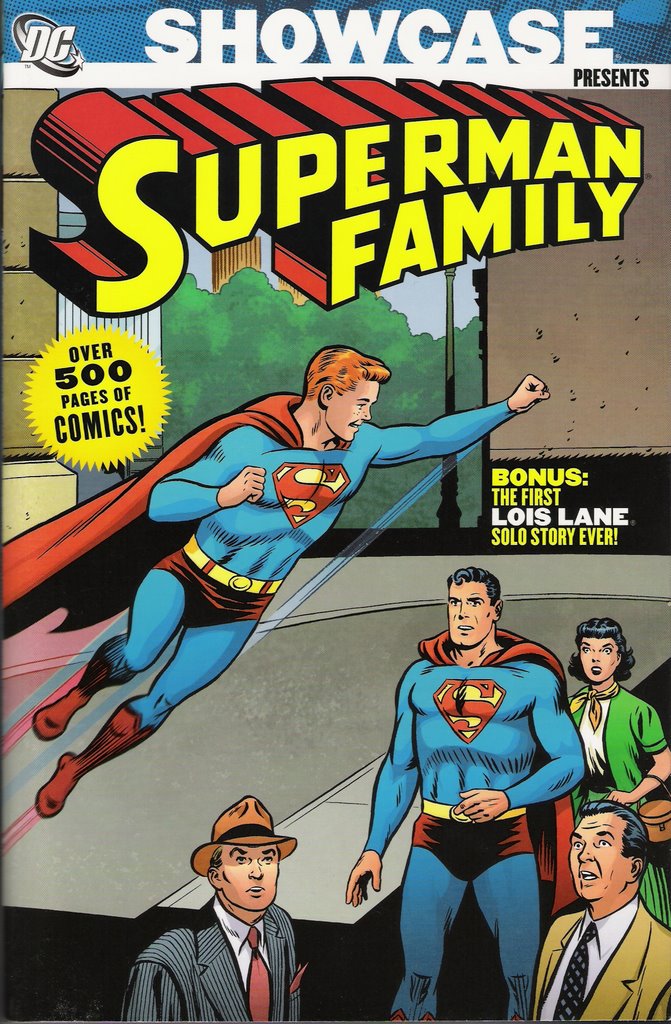
Yes, once upon a time comic books were so popular with children (as opposed to weird adults) that not only did Superman have two series (Action Comics & Superman), but even his supporting cast members like Jimmy Olsen and Lois Lane could support their own series. Showcase Presents: Superman Family vol. 1 celebrates those halcyon days of comics publication. Like other titles in the Showcase Presents series, Superman Family reprints five hundred pages of DC Silver Age adventures. Superman Family essentially contains the first twenty-two issues of Superman’s Pal, Jimmy Olsen, but because it includes Lois Lane’s first solo story it had to be renamed. Presumably future volumes will not only contain stories from the pages of Jimmy Olsen, but will also publish reprints of Superman’s Girl-Friend: Lois Lane, a title that premiered later.

The inclusion of the Lois Lane material can only be a good thing, as I really dig the I Love Lucky romantic comedy zaniness of the early issues and find the “feminism” of the later issues to be curiously entertaining if not inspiring. The inclusion of the Lois Lane material will also probably improve the overall quality of the volume, because the Jimmy Olsen issues tend to be less successful than what I read in Showcase Presents: Superman.

While the Superman material tends to be formulaic, the stories do tend to show more cleverness and play within that formula than those in Jimmy Olsen. While I like Jimmy Olsen in theory because he’s the most any of us can be by being a friend of the gods, in practice reading about the friend of the gods can get quite boring. In general, Jimmy discovers the plan of some local mobster who must, as union rules dictate, have some moniker like “Lucky” or “Legs” in quotes. Jimmy tries to solve the crime or get the scoop on his own or because he wants to help Superman, but inevitably gets into trouble and either has to have Superman help him secretly or has to ask for help directly by using his signal watch. I’m about half way done with the volume now and it only seems to be getting more and more formulaic. Although to be fair, it might only seem that way because the formula becomes more and more apparent as I read on.

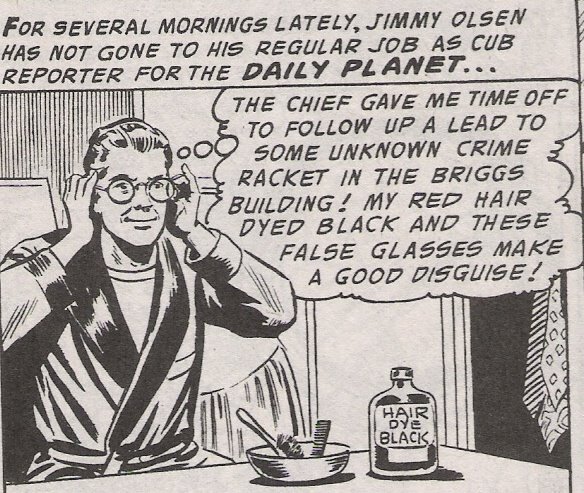
However, there isone issue that isjust simply so great that I have to praise it. Usually, there is nothing more boring than having a comic book story (or fan) explain how a generic convention is actually possible. The issue of Jimmy Olsen that I adore naturalizes the convention that glasses are an adequate disguise without such an explanation. In the issue Jimmy Olsen notices “Loot” Logan (see I’m not lying about the “names”) and other criminals are going to the Briggs Building. Jimmy decides that he will disguise himself as Dick Hunter, Elevator Boy and get the scoop. Unfortunately, Jimmy gets an accidental knock to his noggin and as what tends to happen when one gets hit in the head, suffers amnesia. Jimmy, still in disguise, mistakes himself as Dick Hunter and goes about his day. At one point he sees an advertisement for The Daily Planet that informs readers that Jimmy Olsen is on staff and is Superman’s Pal. Jimmy, as Dick Hunter, envies Jimmy Olsen’s relationship with Superman not realizing that he really is Superman’s most special buddy. Perfect!! Jimmy, even as Dick, is still Jimmy and so he manages to stumble upon the criminals’ scheme (they’re running a crime school), gets in trouble, and after being told by the criminals that he is Jimmy Olsen, has to signal Superman for help.

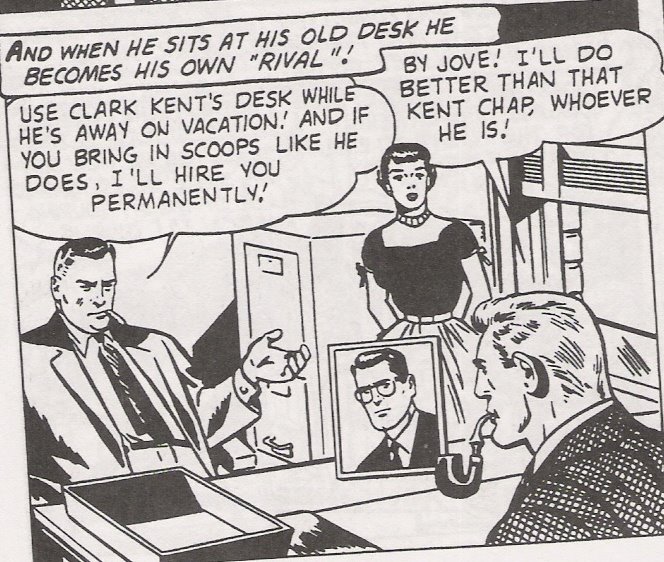
Even though I have some affection for the story, it too proves to be formulaic. Not only that, it’s also pilfered from another Superman comic. In Showcase Presents: Superman vol. 1 my favorite story was one where Superman gets amnesia and disguises himself as Englishman Clarence Kelvin. Kelvin takes a temporary job at The Daily Planet, filling in for Clark Kent while heis on vacation. Starring at a photo of Clark Kent on his desk (why Clark keeps a headshot of himself on his desk is beyond me), Superman does not recognize himself. Olsen’s plot reenacts the entire device, only without the clever twist. At the end of the Sueprman story, Lois feels gratified that she’s finally figured out that Superman is really Clarence Kelvin. Superman, realizing that he has nothing to fear, merely shreds the disguise and says that Lois has got him, but now she’ll have to try and figure out his new identity. In contrast, Jimmy gets knocked on the head again, regaining his memories as Olsen, but cannot remember the adventure he has just had as Dick Hunter. While the last panel does produce pathos, it’s just not as clever.

Future posts if things get better.

Monday, August 7, 2006

Comics vs. Baseball


The past two days have provided me with more reasons why Baseball should be favored over comics, at least seasonally. I saw this morning at
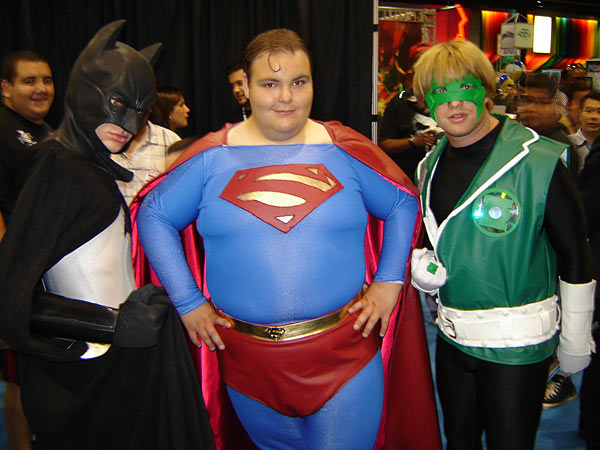
Comic Book Resources pictures from Wizard World Chicago, one of the summer’s big Comics Conventions. The fact that I share an interest with these people is frightening.

While CBR has plenty of pictures of kids dressed up as their favorite characters, for every picture of a young Captain America beaming because he got to go to a convention in costume, there are more than three dozen like the one above. Here Butterball Superman, 15 year old Batman, and what appears to be Keanu Reeves in a bad wig as Green Lantern, pose for their picture. And while it’s obvious that these three like the attention their receiving from the comics fan press and no doubt their fellow fans at the con, there seems to be to be something unreasonable about a fan that goes to such heights. Where Superman’s smirk betrays a confidence, I’m just a little embarrassed for him by how the costume accentuates his man boobs. Is this just an expression of self-neglect and social stigma turned into a strange expression of prideful abnegation? Really, I think there are better ways to go. Even secret shame seems a more dignified response. Or even making fun of those who clearly have no secret shame.

The more positive aspect to this comparison is that I was recently inspired to work out harder by the Dodgers, thus avoiding a Super-Belly and Super-Heart Disease and Super-Diabetes. I was at the gym the other day and the game happened to be on. It was the top of the sixth, and the Dodgers were loosing to the Marlins, one to three. I planned on a fifty minute run and intended to leave when my time was up. But as I was running the Dodgers began to turn the tide, mostly due to the ineptitude of the Marlins’ pitching staff, which walked in three runs. By the end of the seventh inning The Dodgers were up four runs and I was nearly done with my run. Not only did I want to see the end of the game – another post-trade Dodgers victory – but it dawned on me that in running, I was in fact being more athletic than any of the ball players out on the field that day. While certainly they could all outrun me, out hit me, and out field me, a lot of the time they were just standing around waiting for a hit. By running at a constant rate, I was in fact getting more of a work out than they were. When the work out program ended towards the beginning of the eighth I decided to run for the rest of the game, and I ended up running about eight miles for about eighty minutes.

The recruiters should be knocking on my door any day now.

Sunday, July 23, 2006

A Post in Which The Author Comes to Discover Why He Has Become More Interested in Baseball


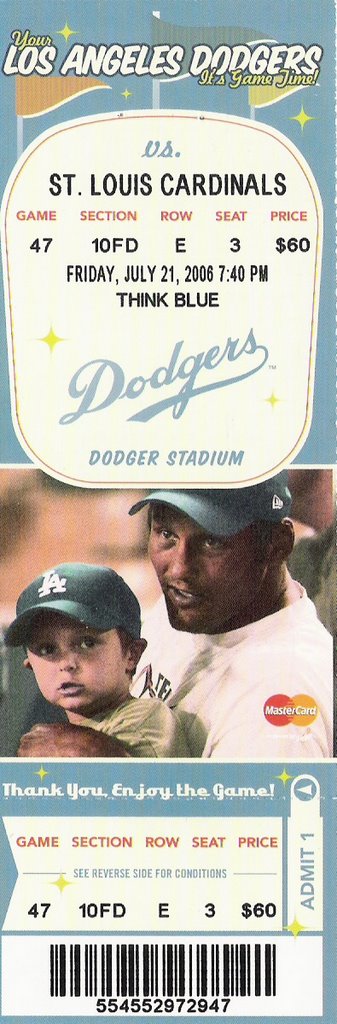
On Friday night I went to see the Dodgers play the St. Louis Cardinals. We had excellent seats – about fifteen rows back from the field just to the right of home plate along the first base line. The Dodgers played well defensively, although I think they should have gotten Brad Penny off of the mound before he gave up a homerun to Chris Duncan. Offensively, they did not do much, only garnering five hits on a full nine innings. And so they lost two – zip at the end of the game. Given the Dodgers run of losses and bad luck to injuries it was more than likely that they were going to lose and I knew that going into the game. However, I suppose part of me will always suspect that the Dodgers should win against the Cardinals because the earliest baseball game I can remember seeing was a match up between the two teams and I can still distinctly remember one of the Cardinals running with the bat. Part of me still believes that the Cardinals must still, even though it’s been probably more than twelve years, really suck. I mean c’mon, even at eight I knew to drop the frickin’ bat

But despite my innate knowledge of just how bad Cardinals must at least secretly stink, the Dodgers offensive performance was disappointing. In the second half of the first inning Jeff Supan of the Cardinals struck the Dodgers’s big stick, J. D. Drew in the knee with a wild pitch taking him out for the rest of the game. I haven’t heard much about his recovery, only that the injury is not expect to be too serious. My new baseball hero, Nomar Garciaparra didn’t get much time to shine as he has in the other games I’ve seen this season. With three AB’s he popped it up to right field in the first, got thrown out later in the game, and was later walked.

But enough about the game itself. I noticed I’m more into baseball this season. Part of the attraction no doubt stems from the fact that I got last seasons EA MLB video game for my Game Cube. I’ve learned a lot more about the game – stuff that I probably should have learned growing up because I’m male and American. The other factor in my growing interest in Dodgers baseball is my hatred of Orange County and my proximity to the Angels, who I’ve always kind of suspected as being the WASP-Country Club team of Southern California. But I think my growing interest in Dodgers baseball has really lied in my decreasing interest in the comics that are being produced these days. Despite some of my posts, the stuff being put out by DC Comics (my company of choice) has just been boring and total dreck, and for the first time in many years I’m no longer a Wednesday buyer. Instead, I got a few subscriptions and when I’m in L.A. I’ll occasionally go to the shop and pick up something that I can’t get through the mail. Since something has to fill the “hobby hole” in my life, and its summer, baseball seems like a good substitution. It has some similarities, in that both possess a lore of trivia and have distinctive personalities and allow you to have irrational favorites. The upside of liking baseball in comparison to comics is that less people will begin to snore when you want to talk about it. Plus, baseball fans are not, on average, as scary as comics fans.

Anyone want to go to a game this season?

Thursday, June 29, 2006

Superman Returns


It probably will not come as a surprise that I saw Superman Returns on opening day. While there are numerous filmic arguments that I would like to make (first among them is how the film is a literal re-scripting of the first film from 1978), none of them seem intellectually honest at the moment. For what has always brought me to Superman has been my heart.

Because of this, I will tell everyone my favorite part of the movie and why it is scenes like this that draw me to the Man of Steel and to the superhero genre in general. Early in the film, we see Superman sitting on Martha Kent's couch in Smallville watching television. He has been away for five years, exploring space and as such has lost touch with the events of Earth. Watching TV, he flicks through news report after news report. The expression on his face says it all. When Superman watches tragedy after tragedy on the news he does not see it as we see it and Brandon Routh does an excellent job of conveying this fact. For when I watch the news and hear of tragedy or hardship I either watch passively, viewing the event as something very removed from my life, or watch it sadly, knowing that there is not much that I can do to ameliorate the situation. When Superman watches the news, a flash of anger crosses his face but it is tempered with determination. For Superman knows that he is capable of leaping tall buildings in a single bound, that he is faster than a speeding bullet, and that he is more powerful than a locomotive. In short, Superman knows that he can do something about it.

A scene like this is also in a film of a much lower caliber, Teenage Mutant Turtles. In that film the vigilante Casey Jones (for those of you who don’t remember (and consider yourself lucky) Jones is a cross between Travis Bickle and Jason), watches the news and decides that he will fight crime. But Jones watches the news differently than Superman. Jones watches the news like it is particularly violent pornography and it cannot help but to inspire him to commit equally violent actions. Jones wants to hurt the people he's feed up with. It's not about decency; it's all about revenge and violence. However, what makes me like Superman more than all other superheroes is that Superman stands for as Perry White says in this film, "Truth, Justice, and the rest of it." Superman fights the good fight not because he’s driven by revenge or because he wants fame or power, but because he can; and because he can, he knows that he must. What always remains inspiring to me about Superman is not that it makes you want to believe for a second that a man can fly but that he is intrinsically good. And I've never found a good reason for turning away from the intrinsically good, no matter how cornball it may seem.

Friday, May 19, 2006

Alan Moore's Punishment


Jerry Christensen is totally right.

For those few readers who are not of the UCI persuasion, right now I’m taking a class with our department chair, Jerry Christensen on Classical Hollywood Cinema. J. C.’s basic thesis is that we should not read films as works of an individual (as auteur theory would teach us) or even as a collaborative work (as common sense would teach us) but as an expression of corporate speech (as J. C. is teaching us). As such we have been looking at what elements compose a studio style. Typical questions have been: What makes this an MGM film? How would this be different if Warner Brothers were the studio? On the whole I’ve found this class to be engaging and ever since I found out about J. C.’s ideas about corporate authorship last year in the 1950s class he co-taught, I’ve been curious to see how they might apply to America’s other great corporate art, comic books.

Such an expression can be found on DC Comics recently launched website 52thecomic.com. Established to support their new weekly series 52, the website is designed to appear to be the online addition of that great, fictional, Metropolitan newspaper, The Daily Planet. As such it is replete with advertising and stock quotes from the fictitious corporations that appear in the DC Universe. As such we see ads for LexOil, The Halo Corporation, and Sivana Industries. While we might want to take note of how many of these companies are controlled by super-villains, all of these conglomerates have appeared in the pages of DC Comics before. However, besides LexOil, the most prominent “ad” on the website is for Sundoller Coffee, a company never before introduced in any of DC’s titles.

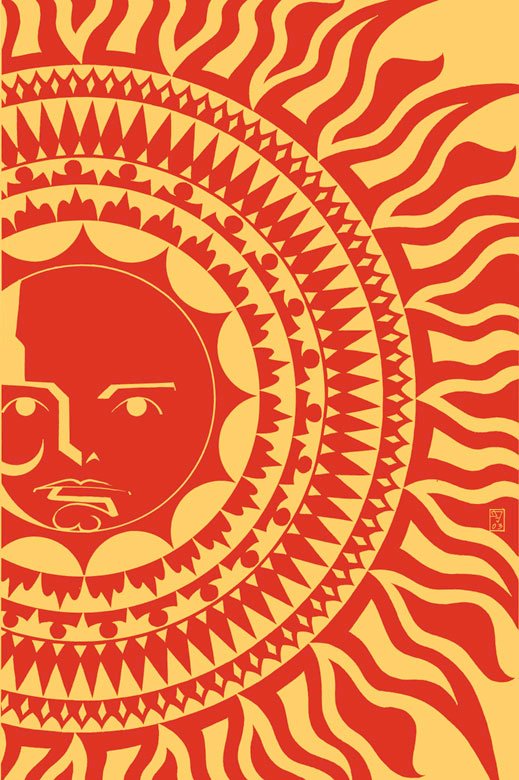
While the mock-article on the website would turn Sundoller Coffee a playful but weak joke at Starbucks expense, it nonetheless seems to be an attack on comics auteur Alan Moore. While the Sundoller logo resembles the iconographic style of Starbucks, it also bares a striking resemblance to the symbols that frequently appeared in Moore’s recently finished series, Promethea. To your right you’ll see the cover of issue thirty of the series. Note the similarity between that and the ad for Sundoller Coffee.

The reason for such an attack has a storied history. Moore has long feuded with the company over their continued ownership of V for Vendetta and Watchmen and has not worked with the company since V was completed in 1989. At the heart of this feud is the fact that Moore feels cheated by the company. When he published V and W he signed a contract that stated that if DC ever let the works fall out of publication, the rights would revert back to him and his collaborators. Unfortunately, twenty years after Watchmen’s initial publication it is still reprinted and continues to not only be a big seller for DC, but is the work that Moore is most associated with. The two are trapped in a symbiotic relationship. DC needs Moore’s old work to maintain some semblance of cultural legitimacy and Moore, at least at one point, was reliant on them to make his name.

However, Moore has long been an established star, and while his name is still heavily associated with his earlier DC work, he has long been able to produce his own material and work on those projects he wanted to. In the mid 1990s he founded America’s Best Comics (ABC) line for Wildstorm studios and created such books as Promethea and The League of Extraordinary Gentlemen. It is fair to assume that when Moore began working for Wildstorm, he never expected Wildstorm to move from Image Comics and sell to DC. When such a merger occurred, all the copyrights that Moore had produced for the company (excluding Extraordinary Gentlemen) became the intellectual property of DC. While Moore begrudgingly stayed on to finish his longer storylines within the “ABC Universe” he kept his distance from DC editorial and interacted with Lee only. This feud, combined with Moore’s own erratic rates of production, meant that his work did not receive much support from DC and really only sold successfully in collections.

The feud between the creator and the company flared up most recently with the adaptation and release of V for Vendetta for Warner Bros., DC’s parent company. Feeling that the work had drifted too far a field from Moore’s original intention and politics, Moore demanded that his name be taken off the film and that his share of the royalties be given to the artist for V, David Lloyd. While Moore did not explicitly tell people to avoid the film, he did condemn the movie and referred to DC Comics in interview as the company that “cheated me out of the ownership of my work and then peddled it to another part of their parent company.” Statements like this, soured fandom’s reception of the film and fostered the creation of Anarchist anti-V websites like this one.

As such, it is easy to see why DC Comics would not be all that happy with Moore. And so it would appear that the words on the Sundoller ad seem specifically chosen to reflect DC’s hostile attitude towards Moore. Picayune is the name for a Spanish coin, but it usually infers something of little value or trivial. This may refer back not to Moore’s older work but to the book that the Sundoller logo takes its basic shape from, Promethea (not exactly a hot commodity). Milieu is clearly the hardest word to place as an insult but according to the OED it may refer to the criminal underworld of France. While there is nothing French about Moore, his work, or DC Comics, this word might be here to invoke Moore’s present outsider status. The second supposed coffee size is called “Malocchio.” While the word has a certain similarity to cappuccino, the word is Italian for the “Evil Eye.” Given Moore’s interest in the occult and particularly its role throughout Promethea this seems the most referential of all the smaller words to Moore. However more probably we can view it as DC giving Moore the Evil Eye for his most recent behavior regarding the release of V. Finally, the word “ego” in big bold print seems to be an obvious marker for Moore, who as an auteur who refuses to work for either of the two major comic book companies seems to be marking himself as somehow “bigger” than perhaps he should.

The advertisement, taken in conjunction with the brief biographical sketch that I’ve traced above, appear to be the first instance of a “genre” in comic books that J. C. has defined as “star punishment.” In classical Hollywood cinema star punishment consists of insulting or punishing characters played by actresses for having gone against the wishes of the corporation. By turning his “star property” Promethea – a clear work of religious devotion if there ever was one – into the subject of a fake advertisement, DC appears to be making a claim for the superiority of publication power and intellectual property over individual creator rights or independent innovation. It can all be replaced to parody and throwaway continuity in the crass world of superheroes.

Wasn’t this better than writing head notes for comps?

Monday, March 6, 2006

Part One (Black History): Reading the Mosaic

Last Friday, I gave my first academic talk and for the most part I think it went pretty well. For those of you who didn't get to hear it, I'm posting it here. If anyone thinks this is career suicide, let me know by posting a comment and I'll take it down. Questions and comments would be helpful. I'm going to try and transform it for an issue of MELUS

I imagine today that today that many of you do not have the dubious distinction of being a scholar of comics and its fandom. I also imagine that many of you have never heard of the Green Lantern title featuring the Cold War adventurer turned space cop with a magic ring, Hal Jordan or its spin off title Green Lantern: Mosaic, which starred Jordan's African American counterpart, John Stewart. And while I was originally tempted to give you a protracted history of Green Lantern franchise those of you who have seen Kill Bill will appreciate the vision I have of Uma Therman screaming, "How long is this going to last" as David Carradien's character when he proceeds to allegorically explain their relationship through the history of Superman.

However, we are not here to talk about my potential failure to hold an audience's attention. We are here to talk about failures and hopefully unique failures at that. It is for this reason I mention Green Lantern: Mosaic, one of the few comic books to have ever featured an African American as its protagonist. Traditionally, books featuring African American characters have failed artistically - because they have not accurately represented blacks and black culture - and economically - because they have failed to sell enough copies to sustain their prolonged publication. Mosaic, while its failures and successes touch on these issues, managed to fail in a way that runs contrary to the superhero genre: ethically.

Like many popular American genres, the representation of blacks in comics has been vexed. As early comic critic and proponent for censorship, Frederic Wertham noted, depictions of blacks in the 1940s were either comical Sambos or threatening looking Ăśbermenschen to pound into the ground (Wertham, 32). However, after the industry-sponsored censorship board took effect in 1954, much to Wertham's delight, such portrayals were verboten. Unable to fulfill the role of comic jester of faceless threat, blacks remained unrepresented throughout most of the 1950s and 1960s. It was only in the early 1970s when publishers, noting the popularity of Blaxploitation films like Shaft (1971) and Superfly (1972), began producing black characters like Luke Cage, Mosaic's own John Stewart then dubbed "Black Lantern," and Black Lightning. While these portrayals were intended to be positive, they tended to be written, drawn, and edited only by white professionals, who reproduced stereotypical depictions of black culture from other media sources. As Christopher Priest, perhaps, comics most renowned African American creator to date, has noted:

Black society in comic books seems an almost invented culture, as made up as Smallville or the Legion of Super-Heroes' headquarters, sewn together by glimpses of television shows or movies. Black culture as represented by Sherman Helmsley or Jimmy Walker or Richard Roundtree. It's an RPG universe subset Black People, with a list of rules and hair styles and speech patterns, invented for the game, but bearing little resemblance to any actual culture (Priest, http://phonogram.us/comics/powerfist.htm, accessed May 03, 2003).

Black culture becomes as real as Black Lightning's Afro; it's just another accessory. This problem has been exasperated because, although there was an explosion of black characters created in the 1970s, the total number of black characters remains very limited. As such, black characters have been overburdened by having to represent all of African American culture with unprofitable results. Dwayne McDuffie, another successful African American creator, has stated his frustration with writing ethnic characters in an otherwise non-ethnic genre by saying, "As a writer. . . my problem . . . with writing a black character in either the Marvel or DC Universe is that he is not a man. He is a symbol. . . You can't do a character. . . Cage is all black people" (Norman 68 in Brown 31).

.

Part Two (Narrative Function): Reading the Mosaic

Gerard Jones, the creative talent behind Mosaic, expressed his concern over being a white writer in charge of depicting African American subjectivity when he wrote sarcastically in the back of the first issue, "Mosaic is two white boys writing and drawing John Stewart. 'Yo, homes! Your script, it's. . . it's. . . it's. . . it's def!' 'Yo, it's easy, man, when my bud's pencils are so fly! that is right, isn't it 'Fly'? That's still au courant in the urban subculture?'" In order to understand and write Stewart effectively, Jones created a character that strayed considerably from the hyper masculine Shaft archetype that the character was originally based upon, and stressed the multifaceted nature of the character and his mind, a mind that Jones could have some things in common with. In an essay that appeared at the end of issue four, Jones described his relationship to Stewart through their mutual and divergent musical tastes. While Stewart likes Streisand and Jones, the Ramones, in the author's words, "Basically, John and I have enough in common that we can figure out what to play when we're together, but we know better than to give each other CDs for Christmas."

Despite the fact that Jones showed an early interest in being capable of writing a black character who was both fully developed and not beholden to stereotypes, the narrative logic of Mosaic is arranged in such a way as to deem this epistemological problem unnecessary. Mosaic takes place on a composite planet - one made up of cities from across the cosmos that have been snatched by a rogue member of the Green Lantern Corps overseers. When the threat of the mad Guardian is eliminated the rest of the Guardians decide that the composite planet provides an excellent opportunity to see what happens when displaced cultures, naturally given to disagree with their neighbors, have to live with one another, and if John Stewart can make such an arrangement work.

On such a planet, where everyone is estranged, where everyone is dislocated, John Stewart blackness is metaphorically tied to being an alien. In the first issue, as Stewart introduces the Mosaic world to his readers, he says, "Get the picture? I'm an Alien. Is that why I'm here? Is this the home I never found, where everyone is an alien?" However, on a planet where black estrangement becomes the normative psychic condition, not only does John Stewart became an alien as it were, but everyone, both alien and American white, become in a sense black.

The connection is made poignantly clear in the final conflict in the series: John Stewart versus a resurgent Klu Klux Klan. Addressing a rally of cross burners, the local Grand Wizard proclaims, I think we can all agree that the African-American is just as alien and evil as any monster from outer space. . ." This sort of conflation occurs again when one of his fellow conspirators talks about their alien neighbors' desires, "They want to mate with human females." Without so much as a pause, another Klu Klux Klan member says, "Stewart can have his pick of all the white women on the Mosaic. He's shacking up with one now. He can push us around with his ring. Why would he want to send us home?" The Klu Klux Klan's position is flawed however not just because it is racist, but because they fail to see their true situation. After dealing with a destructive raid, a Klan sympathizer asks Stewart to see the Klan's position - how cruel it must be to be to be torn from your cultural context in order to serve someone else's means. In a series of aspect panels, which highlight the anger and tension present on Stewart's face, the Mosaic's protector parodies the man's words before cutting him down, "Torn from your native world. . . someone else's purpose. . . cut off from your culture. . . forced to assimilate. Don't I see how cruel that is? Look at my skin." Although John leaves angrily, it is clear that in a fragmented world, both racist and black inhabit the same psychic position.

Although this positioning of the characters complicates normative assumptions of authenticity, the series does not rest at negotiating authenticity purely in psychological terms. Given the mandate to bind these cities together in a functional metropolis, Stewart, an architect when not serving as Green Lantern, decides the best way to do so is physically, by building a long expanse of road through the cities. The purpose for doing so is not to merely allow for unimpeded transportation, but to allow for commerce. As John states, "Goods will bring the Mosaic together. We will create consumption communities here, and we will link them in a web of economic interdependence, just like the web that spreads over the Earth. But to do that we need the road."

This theme of consumption is made apparent in the form of Trendoids, a species who seem to be an allegorical representation of the culture industry. They become a problem for Stewart to deal with when they begin to imitate and commercialize the culture of minority groups much to the annoyance of those being imitated. The Trendoids view themselves as unable to reclaim their original culture as they come from a conquered race, who in order to survive, have for millennia adopted the values of their host culture. John's initial solution is to restore the authenticity to Trendoid culture, however pragmatic architect that he is, he resolves instead to redistribute the Trendoid population so that they are steeling evenly from all of Mosaic's various cultures. In a compositional shot that has Stewart face both reader and Trendoid, he states, "We used to make fun of 'white negroes' on my world. The white be-boppers and beasts. And 'oreos,' The blacks in suits and ties. But in the long run. They brought our peoples closer. We sill talk about plain white rapperes' and 'buppies.' They irritate the purists. But they'll do the same. They'll bridge the gap. I need you to do that for me." While the Trendoids don't understand, they do think it will be fun (much in the same way that the comic the reader has in his hand is intended to be fun). The value of the Trendoids have in uniting the Mosaic, inauthentic as they may be, questions the very usefulness of authenticity. Authenticity in this configuration is used to drive people apart, but hybrid-identities like the Trendoids, the "white negroes" and the "buppies" are figured as being more useful in a project of integration. It is this form of hybrid-identity that the series asks not only the Trendoids to have, but the readers of Mosaic as well in order to help "bridge the gap."


Part Three (Economics)

If it is by making the value of authenticity problematic that Mosaic avoids the common pitfall of stereotypical black protagonists, it is important to address how it avoids the economics failure of low sales. Poor sales have long been a problem for titles that prominently feature African American characters. Although this is more than likely caused by the industry's unwillingness to widen its pool of readers by advertising in the African American community, the logic behind this failure has been best expressed by comics writer and editor Roy Thomas who has stated, "You could get blacks to buy comics about whites, but it was hard to get whites to buy comics in which the main character was black."

At first glance, it may seem odd to state that Mosaic was not a victim of low sales, as it ran for only eighteen issues from June 1992 to November 1993 - a time of great financial growth in the industry. Relative to other black superhero titles, the length of its run is in the mid-range, between Luke Cage's nearly fifty issue run, but better than Black Lightning's eleven issues, or Black Goliath's five issue foray into the world of super-heroics. However, what is important to note is that Mosaic was not canceled because it was unprofitable, but because of the fear that it would become so. As Gerard Jones related to the fan press, the series was not canceled because it was performing badly but because DC Comics publisher Paul Levitz and senior editor Mike Carlin "felt it would inevitably lose sales, although I don't feel the evidence was there for that." The failure then is not in the cancellation of the title; the cancellation of the title because DC feared the title would fail, reflects a much deeper failure in terms of rhetoric and by extension ethics. This type of failure illuminates the temerity of DC Comics management to speak to, as Mosaic endeavored, comics' core constituency as more than just fans or consumers and to encourage these fans to be more poetically minded.

Sunday, March 5, 2006

Part Four (Rhetorical Function): Reading the Mosaic


For all its talk about politics and race, it is unlikely that Jones cared particularly much for either in his fiction work. Before becoming a professional comics creator, Jones publishing a book on comics where he criticized Denny O'Neil and Neal Adam's well thought of tenure on Green Lantern/Green Arrow, a tenure where O'Neil brought the political and racial conflicts of the day to the forefront in order to give comics what was then termed "relevancy." Jones felt that the title was "ultimately unsatisfying" because "it was hard to believe that the protector of an entire galactic sector could fall apart at the sight of a slum unless, that is, a writer contrived it so." This sentiment expressed itself while Jones was working on the principle Green Lantern title in September of 1992, when he scripted a scene that made explicit reference to Green Lantern/Green Arrow's most famous scene. In the original Green Lantern meets the indignation of an elderly black man who asks him, "I been readin' about you. . . how you work for the blue skins. . . and how on a planet someplace you helped out the orange skins. . . and you done considerable for the purple skins! Only there's skins you never bothered with! The black skins! I want to know. . . how come!?" A shamed face Jordan can only look down and responds hesitantly, "I. . . can't." The mock up retains the same basic composition, but replaces the black man with a blue skinned alien who is given traditional African American facial features. He asks Jordan not what he has done for blacks or other minority groups, but what he has done for aliens. Jordan, seemingly in on the joke, turns not to the alien or the floor, but to the reader and responds, "Now I ask you. . . what am I gonna do?"

The reason why Jones was so reliant on the idiom of the political in Green Lantern: Mosaic was because it was the only tool the genre left at his disposal to transform his work into something that could be deemed literary and himself into what he really wanted to be: a comic book auteur in the mold of Alan Moore and Frank Miller. And although Moore and Miller's mid-1980s work dealt with the political without dealing with race in any concrete way, working within the Green Lantern franchise, John Stewart's race seems like the most obvious way to achieve, what he chided O'Neil for, forced "relevancy." This reluctance to include political material was a times in Stewart's own desire to be more like Hal. In one sequence we catch John reading reprints of 1960s Green Lanterns. A smile on his face betrays a deep satisfaction and the envy that unlike Jordan he can't win his fights by "invoking arcane scientific principles."

No matter how resistant Jones might have been to doing a political book, nonetheless he realized that the politics of the Mosaic was his best opportunity to achieve the artistic status that he desired so fervently in the letter pages. Discussing his time working in a used bookstore, Jones told his audience, "I became more convinced than ever that I would Die in Agony if I did not Become a Writer." Working within the formulaic world of superheroes he needed John in order to not just be a self-described "Hack," just as the usually narratively subordinated John mentions needing the Mosaic world, to find his own voice. Addressing the reader once again, John informs us that, "the courage to use your own voice. That's the test of maturity. That's the proof of seriousness. Maybe that's my mission here. To find my voice."

Of course voice means nothing if you don't have an audience, and it is here where Jones's rhetoric and the form of the comic narrative begin to reinforce each other. An unusual formal device utilized throughout the Mosaic series, particularly given the genre, was to have Stewart speak directly to the audience, convincing the reader of his position and his goals. However, as the series progressed, other characters were allowed to speak directly to the audience and give their point of view. For instance, the issue dealing with the Trendoids begins with a Chicano low rider, announcing his annoyance about the cultural copycats. The issue then follows the low riders until he meets one of Stewart's teenage assistants, who then takes over the narration. However, while they are both capable of speaking for themselves, neither of them are capable of managing the Mosaic. It is only when John takes over the narration in this sequence, that progress is made. While he still allows others to speak, he selects those from the community that he wants to represent and shows his mastery over them on the next page by sitting on top of the images of those talking.

This formal aspect is reproduced textually in the letter pages of the issue. While it was not unusual for writers to answer fan letters themselves, it was unusual for those letters to be so heavily edited and sandwiched by the author's own words and commentary. Just as Stewart selects those voices which will speak for their respective communities, Jones chooses which letters and what part of the letter to include in his text, while providing commentary on each. Just as Stewart is capable of shaping if not his audience, then at least the perception of his audience.

Early letter pages are filled with fannish questions concerning the limits of John's power ring and demands for favorite characters to appear. As one reformed fan admitted in a later issue, they initially bought "Mosaic for continuity's sake. In other words, I didn't want to miss something in Mosaic that I would need to know in Green Lantern or [Justice League Europe] or whatever." However, as the series progressed more and more fans wrote in either to compare the series favorably to DC Comics more avant-garde Vertigo line or to discuss their own experiences with race vis-a-vis the comic. Although a sure sign of the affective fallacy, these letters nonetheless displayed the transformation of readers who would pick up a title merely for the sure thrills of keeping track of characters and plot threads, to those who were willing to discuss race in a provocative way. Indeed, one of the most interesting facets of the series developed when Jones printed an excerpt from a fan named Shander Tabu Mychal Fullove which accused Stewart of being a traitor to his race, "A man who looked objectively at the decadence and oppression of white society would not stand for its recreation once he has the power to do something about it." He then went on to call John Stewart's white girlfriend a "cave-tramp" and to state in capital letters, "A black man who has grown up under pressures such as John will not be able to settle for anything less than black companionship! Jungle Fever was fiction!" And while this is hardly an enlightened view of race relations in the United States, people angry with Fullove's letter and interested in Jones's request for more letters on the topic of race, were more than happy to write in with more nuanced views.

It is here where the two most interesting failures occur. In creating an audience that would talk about race, Jones had desired to remain authoritarian in his role of author. He would allow for speech, but would be responsible for managing it, much in the same way that Stewart allowed for dissent, but set the parameters and prerogatives for the Mosaic's growth. However, through interacting with fans, Jones was loosing his authorial power as innovating genius. Halfway through the series, the author stopped answering letters directly because as he wrote, "I find arguing with you here every month is threatening to affect the way I write Mosaic stories. . . Not good: the pieces of the mosaic have gotta fall where they gotta fall." Indeed, the critiques of the militant African American woman on screen right now (scroll up) seem to be lifted from that month's printed letter by Fullove. The failure of rhetoric here, and where I believe the series would have developed into a much more interesting document is if the language of the fans could have managed to find its way into the text. This would not have questioned Jones's ability to manage the story, but it would have challenged his desired role of genius.

However, the greatest ethical failure of the series comes not with the cancellation of the title, but the decision to cancel it, and the fear that motivated that cancellation> In this decision, the industry revealed its frailty - a frailty that is disturbing since it seems so many of our popular cinematic myths are now being ripped directly from the comics page. While it is unreasonable to expect editors and publishers like Carlin and Levitz to have the moral courage that Green Lantern showed in running the Mosaic experiment, the retreat that DC management made with so little at stake, betrays a temerity that does raise ethical concerns. Although Jones was clearly creating a series out of artistic self-interest, nevertheless the byproduct was a publication that, although probably never capable of challenging politics en mass, and given the cultural politics of Mosaic's narrative, capital, did seem poised to transform a segment of fandom from Comic Book Guy to politically motivated anti-racist citizen. In the final analysis, the ax dropped on Mosaic shows favor to certain types of safe superhero narratives and denies the validity of a transformation more significant than taking off of one's glasses. Indeed, all it shows is its short sightedness.

Any typos or grammatical errors are the result of retyping all of this. Any comments that you have regarding content or argument would be loved and cherished.