Monday, August 7, 2006

Comics vs. Baseball


The past two days have provided me with more reasons why Baseball should be favored over comics, at least seasonally. I saw this morning at
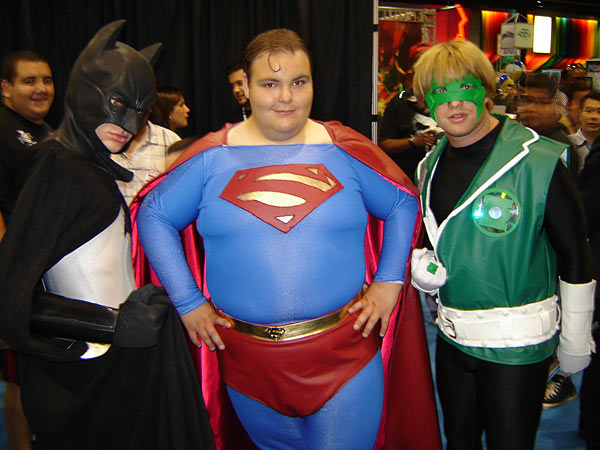
Comic Book Resources pictures from Wizard World Chicago, one of the summer’s big Comics Conventions. The fact that I share an interest with these people is frightening.

While CBR has plenty of pictures of kids dressed up as their favorite characters, for every picture of a young Captain America beaming because he got to go to a convention in costume, there are more than three dozen like the one above. Here Butterball Superman, 15 year old Batman, and what appears to be Keanu Reeves in a bad wig as Green Lantern, pose for their picture. And while it’s obvious that these three like the attention their receiving from the comics fan press and no doubt their fellow fans at the con, there seems to be to be something unreasonable about a fan that goes to such heights. Where Superman’s smirk betrays a confidence, I’m just a little embarrassed for him by how the costume accentuates his man boobs. Is this just an expression of self-neglect and social stigma turned into a strange expression of prideful abnegation? Really, I think there are better ways to go. Even secret shame seems a more dignified response. Or even making fun of those who clearly have no secret shame.

The more positive aspect to this comparison is that I was recently inspired to work out harder by the Dodgers, thus avoiding a Super-Belly and Super-Heart Disease and Super-Diabetes. I was at the gym the other day and the game happened to be on. It was the top of the sixth, and the Dodgers were loosing to the Marlins, one to three. I planned on a fifty minute run and intended to leave when my time was up. But as I was running the Dodgers began to turn the tide, mostly due to the ineptitude of the Marlins’ pitching staff, which walked in three runs. By the end of the seventh inning The Dodgers were up four runs and I was nearly done with my run. Not only did I want to see the end of the game – another post-trade Dodgers victory – but it dawned on me that in running, I was in fact being more athletic than any of the ball players out on the field that day. While certainly they could all outrun me, out hit me, and out field me, a lot of the time they were just standing around waiting for a hit. By running at a constant rate, I was in fact getting more of a work out than they were. When the work out program ended towards the beginning of the eighth I decided to run for the rest of the game, and I ended up running about eight miles for about eighty minutes.

The recruiters should be knocking on my door any day now.

Sunday, July 23, 2006

A Post in Which The Author Comes to Discover Why He Has Become More Interested in Baseball


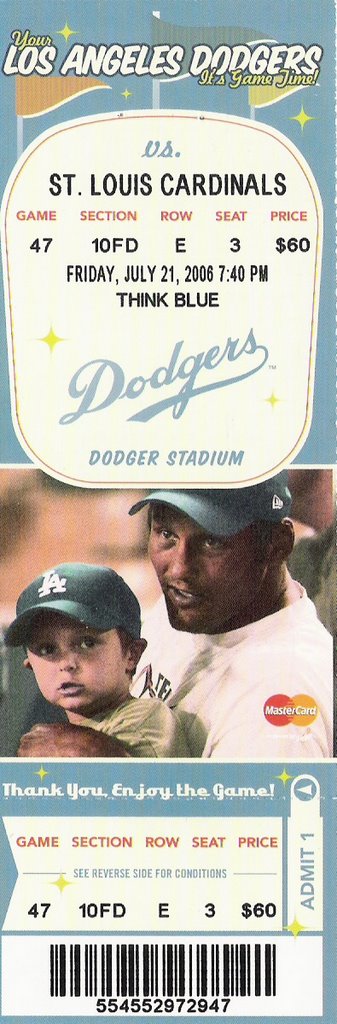
On Friday night I went to see the Dodgers play the St. Louis Cardinals. We had excellent seats – about fifteen rows back from the field just to the right of home plate along the first base line. The Dodgers played well defensively, although I think they should have gotten Brad Penny off of the mound before he gave up a homerun to Chris Duncan. Offensively, they did not do much, only garnering five hits on a full nine innings. And so they lost two – zip at the end of the game. Given the Dodgers run of losses and bad luck to injuries it was more than likely that they were going to lose and I knew that going into the game. However, I suppose part of me will always suspect that the Dodgers should win against the Cardinals because the earliest baseball game I can remember seeing was a match up between the two teams and I can still distinctly remember one of the Cardinals running with the bat. Part of me still believes that the Cardinals must still, even though it’s been probably more than twelve years, really suck. I mean c’mon, even at eight I knew to drop the frickin’ bat

But despite my innate knowledge of just how bad Cardinals must at least secretly stink, the Dodgers offensive performance was disappointing. In the second half of the first inning Jeff Supan of the Cardinals struck the Dodgers’s big stick, J. D. Drew in the knee with a wild pitch taking him out for the rest of the game. I haven’t heard much about his recovery, only that the injury is not expect to be too serious. My new baseball hero, Nomar Garciaparra didn’t get much time to shine as he has in the other games I’ve seen this season. With three AB’s he popped it up to right field in the first, got thrown out later in the game, and was later walked.

But enough about the game itself. I noticed I’m more into baseball this season. Part of the attraction no doubt stems from the fact that I got last seasons EA MLB video game for my Game Cube. I’ve learned a lot more about the game – stuff that I probably should have learned growing up because I’m male and American. The other factor in my growing interest in Dodgers baseball is my hatred of Orange County and my proximity to the Angels, who I’ve always kind of suspected as being the WASP-Country Club team of Southern California. But I think my growing interest in Dodgers baseball has really lied in my decreasing interest in the comics that are being produced these days. Despite some of my posts, the stuff being put out by DC Comics (my company of choice) has just been boring and total dreck, and for the first time in many years I’m no longer a Wednesday buyer. Instead, I got a few subscriptions and when I’m in L.A. I’ll occasionally go to the shop and pick up something that I can’t get through the mail. Since something has to fill the “hobby hole” in my life, and its summer, baseball seems like a good substitution. It has some similarities, in that both possess a lore of trivia and have distinctive personalities and allow you to have irrational favorites. The upside of liking baseball in comparison to comics is that less people will begin to snore when you want to talk about it. Plus, baseball fans are not, on average, as scary as comics fans.

Anyone want to go to a game this season?

Thursday, June 29, 2006

Superman Returns


It probably will not come as a surprise that I saw Superman Returns on opening day. While there are numerous filmic arguments that I would like to make (first among them is how the film is a literal re-scripting of the first film from 1978), none of them seem intellectually honest at the moment. For what has always brought me to Superman has been my heart.

Because of this, I will tell everyone my favorite part of the movie and why it is scenes like this that draw me to the Man of Steel and to the superhero genre in general. Early in the film, we see Superman sitting on Martha Kent's couch in Smallville watching television. He has been away for five years, exploring space and as such has lost touch with the events of Earth. Watching TV, he flicks through news report after news report. The expression on his face says it all. When Superman watches tragedy after tragedy on the news he does not see it as we see it and Brandon Routh does an excellent job of conveying this fact. For when I watch the news and hear of tragedy or hardship I either watch passively, viewing the event as something very removed from my life, or watch it sadly, knowing that there is not much that I can do to ameliorate the situation. When Superman watches the news, a flash of anger crosses his face but it is tempered with determination. For Superman knows that he is capable of leaping tall buildings in a single bound, that he is faster than a speeding bullet, and that he is more powerful than a locomotive. In short, Superman knows that he can do something about it.

A scene like this is also in a film of a much lower caliber, Teenage Mutant Turtles. In that film the vigilante Casey Jones (for those of you who don’t remember (and consider yourself lucky) Jones is a cross between Travis Bickle and Jason), watches the news and decides that he will fight crime. But Jones watches the news differently than Superman. Jones watches the news like it is particularly violent pornography and it cannot help but to inspire him to commit equally violent actions. Jones wants to hurt the people he's feed up with. It's not about decency; it's all about revenge and violence. However, what makes me like Superman more than all other superheroes is that Superman stands for as Perry White says in this film, "Truth, Justice, and the rest of it." Superman fights the good fight not because he’s driven by revenge or because he wants fame or power, but because he can; and because he can, he knows that he must. What always remains inspiring to me about Superman is not that it makes you want to believe for a second that a man can fly but that he is intrinsically good. And I've never found a good reason for turning away from the intrinsically good, no matter how cornball it may seem.

Friday, May 19, 2006

Alan Moore's Punishment


Jerry Christensen is totally right.

For those few readers who are not of the UCI persuasion, right now I’m taking a class with our department chair, Jerry Christensen on Classical Hollywood Cinema. J. C.’s basic thesis is that we should not read films as works of an individual (as auteur theory would teach us) or even as a collaborative work (as common sense would teach us) but as an expression of corporate speech (as J. C. is teaching us). As such we have been looking at what elements compose a studio style. Typical questions have been: What makes this an MGM film? How would this be different if Warner Brothers were the studio? On the whole I’ve found this class to be engaging and ever since I found out about J. C.’s ideas about corporate authorship last year in the 1950s class he co-taught, I’ve been curious to see how they might apply to America’s other great corporate art, comic books.

Such an expression can be found on DC Comics recently launched website 52thecomic.com. Established to support their new weekly series 52, the website is designed to appear to be the online addition of that great, fictional, Metropolitan newspaper, The Daily Planet. As such it is replete with advertising and stock quotes from the fictitious corporations that appear in the DC Universe. As such we see ads for LexOil, The Halo Corporation, and Sivana Industries. While we might want to take note of how many of these companies are controlled by super-villains, all of these conglomerates have appeared in the pages of DC Comics before. However, besides LexOil, the most prominent “ad” on the website is for Sundoller Coffee, a company never before introduced in any of DC’s titles.

While the mock-article on the website would turn Sundoller Coffee a playful but weak joke at Starbucks expense, it nonetheless seems to be an attack on comics auteur Alan Moore. While the Sundoller logo resembles the iconographic style of Starbucks, it also bares a striking resemblance to the symbols that frequently appeared in Moore’s recently finished series, Promethea. To your right you’ll see the cover of issue thirty of the series. Note the similarity between that and the ad for Sundoller Coffee.

The reason for such an attack has a storied history. Moore has long feuded with the company over their continued ownership of V for Vendetta and Watchmen and has not worked with the company since V was completed in 1989. At the heart of this feud is the fact that Moore feels cheated by the company. When he published V and W he signed a contract that stated that if DC ever let the works fall out of publication, the rights would revert back to him and his collaborators. Unfortunately, twenty years after Watchmen’s initial publication it is still reprinted and continues to not only be a big seller for DC, but is the work that Moore is most associated with. The two are trapped in a symbiotic relationship. DC needs Moore’s old work to maintain some semblance of cultural legitimacy and Moore, at least at one point, was reliant on them to make his name.

However, Moore has long been an established star, and while his name is still heavily associated with his earlier DC work, he has long been able to produce his own material and work on those projects he wanted to. In the mid 1990s he founded America’s Best Comics (ABC) line for Wildstorm studios and created such books as Promethea and The League of Extraordinary Gentlemen. It is fair to assume that when Moore began working for Wildstorm, he never expected Wildstorm to move from Image Comics and sell to DC. When such a merger occurred, all the copyrights that Moore had produced for the company (excluding Extraordinary Gentlemen) became the intellectual property of DC. While Moore begrudgingly stayed on to finish his longer storylines within the “ABC Universe” he kept his distance from DC editorial and interacted with Lee only. This feud, combined with Moore’s own erratic rates of production, meant that his work did not receive much support from DC and really only sold successfully in collections.

The feud between the creator and the company flared up most recently with the adaptation and release of V for Vendetta for Warner Bros., DC’s parent company. Feeling that the work had drifted too far a field from Moore’s original intention and politics, Moore demanded that his name be taken off the film and that his share of the royalties be given to the artist for V, David Lloyd. While Moore did not explicitly tell people to avoid the film, he did condemn the movie and referred to DC Comics in interview as the company that “cheated me out of the ownership of my work and then peddled it to another part of their parent company.” Statements like this, soured fandom’s reception of the film and fostered the creation of Anarchist anti-V websites like this one.

As such, it is easy to see why DC Comics would not be all that happy with Moore. And so it would appear that the words on the Sundoller ad seem specifically chosen to reflect DC’s hostile attitude towards Moore. Picayune is the name for a Spanish coin, but it usually infers something of little value or trivial. This may refer back not to Moore’s older work but to the book that the Sundoller logo takes its basic shape from, Promethea (not exactly a hot commodity). Milieu is clearly the hardest word to place as an insult but according to the OED it may refer to the criminal underworld of France. While there is nothing French about Moore, his work, or DC Comics, this word might be here to invoke Moore’s present outsider status. The second supposed coffee size is called “Malocchio.” While the word has a certain similarity to cappuccino, the word is Italian for the “Evil Eye.” Given Moore’s interest in the occult and particularly its role throughout Promethea this seems the most referential of all the smaller words to Moore. However more probably we can view it as DC giving Moore the Evil Eye for his most recent behavior regarding the release of V. Finally, the word “ego” in big bold print seems to be an obvious marker for Moore, who as an auteur who refuses to work for either of the two major comic book companies seems to be marking himself as somehow “bigger” than perhaps he should.

The advertisement, taken in conjunction with the brief biographical sketch that I’ve traced above, appear to be the first instance of a “genre” in comic books that J. C. has defined as “star punishment.” In classical Hollywood cinema star punishment consists of insulting or punishing characters played by actresses for having gone against the wishes of the corporation. By turning his “star property” Promethea – a clear work of religious devotion if there ever was one – into the subject of a fake advertisement, DC appears to be making a claim for the superiority of publication power and intellectual property over individual creator rights or independent innovation. It can all be replaced to parody and throwaway continuity in the crass world of superheroes.

Wasn’t this better than writing head notes for comps?

Monday, March 6, 2006

Part One (Black History): Reading the Mosaic

Last Friday, I gave my first academic talk and for the most part I think it went pretty well. For those of you who didn't get to hear it, I'm posting it here. If anyone thinks this is career suicide, let me know by posting a comment and I'll take it down. Questions and comments would be helpful. I'm going to try and transform it for an issue of MELUS

I imagine today that today that many of you do not have the dubious distinction of being a scholar of comics and its fandom. I also imagine that many of you have never heard of the Green Lantern title featuring the Cold War adventurer turned space cop with a magic ring, Hal Jordan or its spin off title Green Lantern: Mosaic, which starred Jordan's African American counterpart, John Stewart. And while I was originally tempted to give you a protracted history of Green Lantern franchise those of you who have seen Kill Bill will appreciate the vision I have of Uma Therman screaming, "How long is this going to last" as David Carradien's character when he proceeds to allegorically explain their relationship through the history of Superman.

However, we are not here to talk about my potential failure to hold an audience's attention. We are here to talk about failures and hopefully unique failures at that. It is for this reason I mention Green Lantern: Mosaic, one of the few comic books to have ever featured an African American as its protagonist. Traditionally, books featuring African American characters have failed artistically - because they have not accurately represented blacks and black culture - and economically - because they have failed to sell enough copies to sustain their prolonged publication. Mosaic, while its failures and successes touch on these issues, managed to fail in a way that runs contrary to the superhero genre: ethically.

Like many popular American genres, the representation of blacks in comics has been vexed. As early comic critic and proponent for censorship, Frederic Wertham noted, depictions of blacks in the 1940s were either comical Sambos or threatening looking Übermenschen to pound into the ground (Wertham, 32). However, after the industry-sponsored censorship board took effect in 1954, much to Wertham's delight, such portrayals were verboten. Unable to fulfill the role of comic jester of faceless threat, blacks remained unrepresented throughout most of the 1950s and 1960s. It was only in the early 1970s when publishers, noting the popularity of Blaxploitation films like Shaft (1971) and Superfly (1972), began producing black characters like Luke Cage, Mosaic's own John Stewart then dubbed "Black Lantern," and Black Lightning. While these portrayals were intended to be positive, they tended to be written, drawn, and edited only by white professionals, who reproduced stereotypical depictions of black culture from other media sources. As Christopher Priest, perhaps, comics most renowned African American creator to date, has noted:

Black society in comic books seems an almost invented culture, as made up as Smallville or the Legion of Super-Heroes' headquarters, sewn together by glimpses of television shows or movies. Black culture as represented by Sherman Helmsley or Jimmy Walker or Richard Roundtree. It's an RPG universe subset Black People, with a list of rules and hair styles and speech patterns, invented for the game, but bearing little resemblance to any actual culture (Priest, http://phonogram.us/comics/powerfist.htm, accessed May 03, 2003).

Black culture becomes as real as Black Lightning's Afro; it's just another accessory. This problem has been exasperated because, although there was an explosion of black characters created in the 1970s, the total number of black characters remains very limited. As such, black characters have been overburdened by having to represent all of African American culture with unprofitable results. Dwayne McDuffie, another successful African American creator, has stated his frustration with writing ethnic characters in an otherwise non-ethnic genre by saying, "As a writer. . . my problem . . . with writing a black character in either the Marvel or DC Universe is that he is not a man. He is a symbol. . . You can't do a character. . . Cage is all black people" (Norman 68 in Brown 31).

.

Part Two (Narrative Function): Reading the Mosaic

Gerard Jones, the creative talent behind Mosaic, expressed his concern over being a white writer in charge of depicting African American subjectivity when he wrote sarcastically in the back of the first issue, "Mosaic is two white boys writing and drawing John Stewart. 'Yo, homes! Your script, it's. . . it's. . . it's. . . it's def!' 'Yo, it's easy, man, when my bud's pencils are so fly! that is right, isn't it 'Fly'? That's still au courant in the urban subculture?'" In order to understand and write Stewart effectively, Jones created a character that strayed considerably from the hyper masculine Shaft archetype that the character was originally based upon, and stressed the multifaceted nature of the character and his mind, a mind that Jones could have some things in common with. In an essay that appeared at the end of issue four, Jones described his relationship to Stewart through their mutual and divergent musical tastes. While Stewart likes Streisand and Jones, the Ramones, in the author's words, "Basically, John and I have enough in common that we can figure out what to play when we're together, but we know better than to give each other CDs for Christmas."

Despite the fact that Jones showed an early interest in being capable of writing a black character who was both fully developed and not beholden to stereotypes, the narrative logic of Mosaic is arranged in such a way as to deem this epistemological problem unnecessary. Mosaic takes place on a composite planet - one made up of cities from across the cosmos that have been snatched by a rogue member of the Green Lantern Corps overseers. When the threat of the mad Guardian is eliminated the rest of the Guardians decide that the composite planet provides an excellent opportunity to see what happens when displaced cultures, naturally given to disagree with their neighbors, have to live with one another, and if John Stewart can make such an arrangement work.

On such a planet, where everyone is estranged, where everyone is dislocated, John Stewart blackness is metaphorically tied to being an alien. In the first issue, as Stewart introduces the Mosaic world to his readers, he says, "Get the picture? I'm an Alien. Is that why I'm here? Is this the home I never found, where everyone is an alien?" However, on a planet where black estrangement becomes the normative psychic condition, not only does John Stewart became an alien as it were, but everyone, both alien and American white, become in a sense black.

The connection is made poignantly clear in the final conflict in the series: John Stewart versus a resurgent Klu Klux Klan. Addressing a rally of cross burners, the local Grand Wizard proclaims, I think we can all agree that the African-American is just as alien and evil as any monster from outer space. . ." This sort of conflation occurs again when one of his fellow conspirators talks about their alien neighbors' desires, "They want to mate with human females." Without so much as a pause, another Klu Klux Klan member says, "Stewart can have his pick of all the white women on the Mosaic. He's shacking up with one now. He can push us around with his ring. Why would he want to send us home?" The Klu Klux Klan's position is flawed however not just because it is racist, but because they fail to see their true situation. After dealing with a destructive raid, a Klan sympathizer asks Stewart to see the Klan's position - how cruel it must be to be to be torn from your cultural context in order to serve someone else's means. In a series of aspect panels, which highlight the anger and tension present on Stewart's face, the Mosaic's protector parodies the man's words before cutting him down, "Torn from your native world. . . someone else's purpose. . . cut off from your culture. . . forced to assimilate. Don't I see how cruel that is? Look at my skin." Although John leaves angrily, it is clear that in a fragmented world, both racist and black inhabit the same psychic position.

Although this positioning of the characters complicates normative assumptions of authenticity, the series does not rest at negotiating authenticity purely in psychological terms. Given the mandate to bind these cities together in a functional metropolis, Stewart, an architect when not serving as Green Lantern, decides the best way to do so is physically, by building a long expanse of road through the cities. The purpose for doing so is not to merely allow for unimpeded transportation, but to allow for commerce. As John states, "Goods will bring the Mosaic together. We will create consumption communities here, and we will link them in a web of economic interdependence, just like the web that spreads over the Earth. But to do that we need the road."

This theme of consumption is made apparent in the form of Trendoids, a species who seem to be an allegorical representation of the culture industry. They become a problem for Stewart to deal with when they begin to imitate and commercialize the culture of minority groups much to the annoyance of those being imitated. The Trendoids view themselves as unable to reclaim their original culture as they come from a conquered race, who in order to survive, have for millennia adopted the values of their host culture. John's initial solution is to restore the authenticity to Trendoid culture, however pragmatic architect that he is, he resolves instead to redistribute the Trendoid population so that they are steeling evenly from all of Mosaic's various cultures. In a compositional shot that has Stewart face both reader and Trendoid, he states, "We used to make fun of 'white negroes' on my world. The white be-boppers and beasts. And 'oreos,' The blacks in suits and ties. But in the long run. They brought our peoples closer. We sill talk about plain white rapperes' and 'buppies.' They irritate the purists. But they'll do the same. They'll bridge the gap. I need you to do that for me." While the Trendoids don't understand, they do think it will be fun (much in the same way that the comic the reader has in his hand is intended to be fun). The value of the Trendoids have in uniting the Mosaic, inauthentic as they may be, questions the very usefulness of authenticity. Authenticity in this configuration is used to drive people apart, but hybrid-identities like the Trendoids, the "white negroes" and the "buppies" are figured as being more useful in a project of integration. It is this form of hybrid-identity that the series asks not only the Trendoids to have, but the readers of Mosaic as well in order to help "bridge the gap."

Part Three (Economics)

If it is by making the value of authenticity problematic that Mosaic avoids the common pitfall of stereotypical black protagonists, it is important to address how it avoids the economics failure of low sales. Poor sales have long been a problem for titles that prominently feature African American characters. Although this is more than likely caused by the industry's unwillingness to widen its pool of readers by advertising in the African American community, the logic behind this failure has been best expressed by comics writer and editor Roy Thomas who has stated, "You could get blacks to buy comics about whites, but it was hard to get whites to buy comics in which the main character was black."

At first glance, it may seem odd to state that Mosaic was not a victim of low sales, as it ran for only eighteen issues from June 1992 to November 1993 - a time of great financial growth in the industry. Relative to other black superhero titles, the length of its run is in the mid-range, between Luke Cage's nearly fifty issue run, but better than Black Lightning's eleven issues, or Black Goliath's five issue foray into the world of super-heroics. However, what is important to note is that Mosaic was not canceled because it was unprofitable, but because of the fear that it would become so. As Gerard Jones related to the fan press, the series was not canceled because it was performing badly but because DC Comics publisher Paul Levitz and senior editor Mike Carlin "felt it would inevitably lose sales, although I don't feel the evidence was there for that." The failure then is not in the cancellation of the title; the cancellation of the title because DC feared the title would fail, reflects a much deeper failure in terms of rhetoric and by extension ethics. This type of failure illuminates the temerity of DC Comics management to speak to, as Mosaic endeavored, comics' core constituency as more than just fans or consumers and to encourage these fans to be more poetically minded.