Friday, December 2, 2011
Zot
A backward glance, a compassionate caress. In this panel from Zot!, Scott McCloud depicts his titular hero bidding goodbye to his romantic interest, Jenny. Zot must return to his own utopian version of Earth, leaving Jenny to deal with her mundane problems back home. If ever there was a panel that could best encapsulate the collected black and white run of Zot! it is this one. If our hero Zot represents anything, he represents hope and the possibility of change. He is the symbol of better times to come. In contrast, Jenny is a figure grounded in realism, a pessimist at heart who hopes to expatriate herself to Zot's idealized world. In this image, the pair embraces and readies themselves for a kiss that will be all too brief. The issues anthologized in Zot! (1987-1991) deal with teenagers struggling with their own problems, wondering where the future will take them and if they will make their dreams come true.
Scott McCloud is probably better known as a comics aesthetic theorist rather than as a comic book artist. Although academics have taken issue with some of his more hazy generalizations, Understanding Comics (1993), Reinventing Comics (2000), and Making Comics (2005) remain bold efforts to explain how comics work as a medium. Unquestionably, McCloud figured out how comics worked first hand when writing and drawing Zot! in the late 1980s. The book shows the maturation not only of McCloud's characters, but also illustrates the maturation of his artistic talent. While the early stories remain committed exercises in genre, the second half Zot! takes on a quieter more introspective tone that is rarely achieved in today's mainstream, superhero-heavy comic book marketplace.
The first half of Zot! focuses almost entirely on Jenny's trips to Zot's futuristic Earth of "1964." It is a planet that never ages, but is always making social and technological progress. This fantasy Earth serves McCloud's purposes in two ways. The first way is that it allows McCloud to imagine future problems that may besiege mankind in the future. Thus, Zot's super villain adversaries all represent some future menace that mankind better avoid, whether that be primtivism, hyper-capitalism, technological supremacy, or a dehumanizing aestheticism. While the villains are all a lot of fun, they are not the real strength of the first half. Zot's utopian version of Earth provides him a means to talk about the nature of escapism. Jenny's desire to live on Zot's world is really just a way to avoid her own problems. Rather than go into what these problems are exactly, McCloud only hints at Jenny's difficulties. In the first half of the collection, we learn about these problems only from Jenny's thought bubbles or from her conversation. We experience her dilemmas primarily as baggage that she brings with her on her trips to Zot's world. It's a smart move.
In the second half of the collection, McCloud changes the tone of the book radically. Doing so was a risk for McCloud and it took some real chutzpah to do so. The second half of the book finds Zot stranded on Jenny's planet, unable to return home or to facilitate her visits to Earth 1964. Zot remains a fantasy figure in these stories, but his potency as a symbol for escape is not what it once was. Instead, McCloud turns his attention to Jenny's other friends and the mundane but painful struggles they have to endure. Each of McCloud's "Earth Stories," thus focuses on a member of Jenny's nerdy and socially-maladjusted clique as they deal with problems such as family substance abuse; divorce and dysfunctional families; homophobia and coming out; and teenage dating and sexuality. Although these stories are more down-to-earth (or down to our Earth, anyway), McCloud is still extending his original theme. The new characters that McCloud introduces are, like Jenny, trying to make sense of the world while at the same time trying to figure out who they want to be. While the science fiction elements of these stories are minimized, the series remains squarely focused on the future.
One of the aspects of Zot! that made it noteworthy in its day was the influence manga had on McCloud's stories. In the late 1980s, manga was still fairly hard to find in the United States. These days, manga is easily found in chain bookstores and when I walk down the aisle I usually see a good number of teenagers sitting on the floor, working their way through book by book. Manga has also become a stronger visual influence in American comic books as seen in the work of comic book artists like Humberto Ramos, Carlos Pachecho, and Salvador Larroca. However, what seems to be missing in most mainstream comic books today, and what should serve as the real lesson of McCloud's early work, is that character has to come before both marketing and spectacle. McCloud's stories still work today because human emotion remains central to their drama. Reading an issue of Zot! I never get the sense that "nothing-will-be-the-same-again" or "everything-I-knew-was-a-lie," but I do come to understand a character better and I do see the consequences of their simple maturation.
Friday, October 14, 2011
Who is the Black Panther?
Title: Black Panther: Who is the Black Panther?
Author: Reginald Hudlin & John Romita, Jr.
Inspired by the decolonization of Africa, Stan Lee and Jack Kirby introduced a new character into the pages of The Fantastic Four in July of 1966. The first prominent black superhero to appear in American comics, the Black Panther was really T'Challa, a costumed adventurer who ruled the fictitious African state of Wakanda. Since his introduction, Black Panther has attracted a solid fan base, but he has been most successful as a supporting character. Whether this is because comic book fans are reluctant to pick up a book that stars an African character is a subject much debated by comic creators and fans alike.
Reginald Hudlin's Who is the Black Panther? (2006) is an attempt to both streamline the character's storyline and to make him a more prominent figure in Marvel's publishing line. In the back of the collection, Marvel has provided readers with what I assume is Hudlin's pitch for the series. Here, Hudlin establishes that he wants his run to be an iconic version of the character--something that Marvel could base a film franchise upon. (In 2009, the series would serve as the basis for a cartoon on NET). No doubt, this was a smart move given Marvel's recent forays into film. In his attempt to define the character for his editors, Hudlin writes:
The Black Panther is the Black Captain America. He's the embodiment of the ideals of a people. As Americans, we feel good when we read Captain America because he reminds us of the potential of how good American can be, if, of course, we have the conviction to live by the principles the country was founded on. As a black person, the Black Panther should represent the fulfillment of the potential of the Motherland.For the most part, Hudlin succeeds in writing the "movie version" of the character. Who is the Black Panther? has a strong narrative thrust that would play well on the big screen. Of course, Hudlin is assisted admirably by veteran comic book artist John Romita, Jr., who uses wide panels to reproduce the experience of cinema. In the first chapter of the collection, the pair effectively defines not only who the Black Panther is, but what makes the nation of Wakanda so significant. Unlike the rest of Africa, Wakanda is a technologically advanced society that has never been conquered by another nation. They have always remained free of colonial rule. Hudlin's plot hinges on whether or not that will remain the case.
At times, Hudlin and Romita are capable of subtlety. When the United States plans an invasion of Wakanda and the assassination of T'Challa, we can see a sense of conflict on the face of Secretary of State Ms. Reese (an obvious surrogate for Condoleezza Rice). She is simultaneously disgusted by a racist U. S. military culture, proud of Wakanda's accomplishments, and perhaps, willing to attack the nation simply to prove her patriotic bona fides. Similarly, Hudlin is also willing to showcase the xenophobia of the Wakandas whose technological superiority manifests itself in arrogance and disdain for the outside world.
However, more often than not Hudlin goes too far in his effort to establish T'Challa and Wakanda as real "bad@asses" (his word, not mine). Instead of simply invading Wakanda, the U. S. covertly funds a crack team of super villain mercenaries. Super villains are a natural fit for any superhero series, but Hudlin goes too far by making the villains representative of Africa's colonizers: Belgium, Britain, France, and the United States. This is heavy handed and in the case of the U. S., not entirely accurate historically . Even here, Hudlin doesn't leave well enough alone and also attempts to indict Christianity's role in colonization of Africa. Thus, Hudlin creates a Church conspiracy (shades of The Da Vinci Code) in order to indict Christianity's troubling past in Africa. In doing so, he makes the British villain, the Black Knight, the Church's sworn servant. Readers are conveniently supposed to forget that England has been a Protestant nation since the 16th century. And then, at the end, there are the zombie cyborg marines whom T'Challa scares off with a few words. Is that too much? I suppose that depends on your sensibilities.
All and all, Hudlin's Black Panther is an engaging read, but at times its politics are--if not black and white--capable of only four colors.
Tuesday, July 29, 2008
Second Post: The Dark Knight (2008)
My wife often likes to say that a single shot can justify an entire film. Because of this, I have dubbed her a formalist. She is OK with this, even though I make this comment as a fairly committed historicist.That being said, there is a shot in The Dark Knight that would justify the film, if of course the film needed it. Let the gushing and the spoilers commence:
At the end of the film, the Joker falls off the side of a building after battling with the Batman. Unlike "the poetry" of Batman (1989), Nolan's Dark Knight does not leave the clown prince of crime to fall to his death. Instead, Batman rescues Joker from his demise by pulling him up with a grappling hook. Hoisted upside down from his leg and flapping in the wind, the Joker explains his philosophy of life. However, tellingly, the image that the audience sessis not of the Joker hanging upside down. The image has been inverted so that he appears right side up, with his jacket floating up behind him and flapping eerily in the wind. For the audience, this simple trick of inverting the negative's direction produces a certain amount of estrangement. The Joker appears at once normal, but the world appears strange. More tellingly though, is that the shot is from Batman's point of view. As I discussed in my last post and over here, the real tragedy in the film comes when Batman accepts the Joker's view of society. This shot is brilliant, and again would justify the film if it needed it, because it manages to formally suggest the thematic circumstances of that part of the film.
I will stop thinking about The Dark Knight,
I will stop thinking about The Dark Knight. . . .
Sunday, July 20, 2008
The Dark Knight (2008)
I. In the most recent issue of The New Yorker, critic David Denby states that the latest installment of the Batman franchise, The Dark Knight (2008), is little bit more than a ponderous excuse for "thunderous violence." For Denby, watching The Dark Knight is to see the Batman franchise polluted. The new film, Denby writes, "continue[s] to drain the poetry, fantasy, and comedy out of Tim Burton's original conception for Batman (1989), completing the job of coarsening the material into hyperviolent summer action spectacle" (92).
There are a number of problems with this statement, and we would be good to point out the most blatant of these first. Batman was just as much a summer action spectacle as the current film. While time may have shrouded Denby's memory, I distinctly remember that the film came out in late June, which is very much a part of the summer. Furthermore, while The Dark Knight promises to be a commercial success and does have its fair share of crass merchandising, this latest production does not seem nearly as coarse or "un-poetic" as this nation's second wave of Bat-Mania.
More importantly, we must note that, while it is true that Tim Burton had a conception for Batman in the late 1980s, it would be false to say that he ever had the"original conception" for Gotham's protector or that his should be held up before all others. In 1989, the character was some 50 years old, and while Burton's take on the caped crusader had its own idiosyncrasies, much like director Christopher Nolan's Dark Knight, Burton's Batman drew its inspiration from equal parts Bob Kane and Frank Miller.
Denby's true critical sin lies, however, elsewhere. The fact that he credits Batman with greater artistic purity and Burton as the prime Batman artiste is not the true problem of his evaluation.
Denby's ultimate fault is that his review commits the ultimate failure of criticism: he fails to see the aesthetic object for what it truly is and instead critiques it against the object that he truly desires. In doing so, Denby commits the same error that all bad fan-criticism does: he demands that the film bend to the needs of his aggressive nostalgia. Many readers of superhero texts do this because our first introduction to a character usually strikes us as the truest. For me, the original Green Lantern will always be Gerard Jones's Hal Jordan, but Showcase Presents: Green Lantern more than illustrates that this version of the character is as deviant from Jordan's 1959 first appearance as Nolan's Batman is from Burton's. However, I do recognize that Jones's interpretation is just as valid as the original and just as valid as the contemporary version of the character. The later writers have surveyed the history of GL stories and have taken those parts of the character's history that seems most useful and speaks most to them and their age.
For Denby, as far as film goes, Burton's vision of Batman is his prime model. It is the Batman that feels most genuine because it meets those expectations of what Batman should be; but of course these were established by Burton and no one else. We must be aware that Burton's Batman is not the Batman, just as it would be impossible to say that Bob Kayne's Batman is the only Batman, even though Kane was the originator of the character. By this point in time, Batman has become a piece of industrial folklore. He is not the common property of the folk, although many people may feel or think that he has become legendary. Indeed, in many ways he has. The character is a legend, but he is also a copyrighted piece of intellectual property owned by a major media corporation. Nonetheless, while there are an infinite amount of Batman's running a long the rooftops of our collective imagination, there are also many different official versions of Batman that DC Comics and its parent corporation Warner Brothers have propagated. Each of these visions are equally valid. All that defines Batman in his purest form is his origin story (a boy swears to rid the world of crime after his parents are murdered before his eyes) and certain costume elements (the cape, the cowl, and some type of bat insignia). All other elements, including Alfred, Robin, Commissioner Gordon, and even Gotham City are superfluous. As a character, Batman has survived without them at various times in his publishing history and it is likely that one or more of these elements will disappear briefly in the future, although probably not for long.
Burton's Batman is, of course, a Batman that we can all recognize, and which a great many of us delighted in when it first came to theaters. It has all of the essential features of Batman, and has a great many of the secondary ones as well. Furthermore, unlike many comic movies that seem principally ashamed of their source material, Batman does not run from its comic origins or even what we might call their own internal logic. Much like those GL scribes listed above, it takes what it needs from the larger history of Batman and Burton makes it his own. It is this action, making Batman one's own, which allows the 1989 production to fit almost perfectly within Burton's larger oeuvre. Batman is principally concerned with outcasts, moodiness, and masquerade. And while, Nolan's Batman Begins (2005) and The Dark Knight are interested in these themes to a certain degree, I am more than happy to see them moved to the background than have them dominate the foreground. For Nolan's preoccupation with Batman is not with the Dark Knight's personal pain - although his mission does drive the plot - but with how cities function and how they need good people to function properly. Much as I find Burton's Batman to produce its own brand of poetry, I am less drawn to its aesthetic and its message, than I am to Nolan's more useful depiction of Bruce Wayne and his effect on Gotham. For while Burton and later Joel Schumacher were preoccupied with Wayne's pain and demons, and while this can make for interesting storytelling, not many of us are going to find ourselves avenging our parents as masked vigilantes. In contrast, Nolan's Batman series, like a heightened, more fantastic vision of David Simon's The Wire might actually teach us something about our present condition more generally.
II.
If we are going to compare The Dark Knight to a superhero film a more profitable comparison exists between The Dark Knight and the last (and hopefully final) installment of the X-Men franchise, X3: The Last Stand. At the core of the Brian Singer/Brett Ratner trilogy is a political meditation, much in the same way that Nolan's Batman films are preoccupied with the politics and corruption of a single American city. As in the latest Batman installment, X3: The Last Stand also considers what happens when the conception of politics is undermined by something more primal.
In Ratner's production, political issues are mapped along multicultural conceptions of identity. Viewing difference as sacrosanct, many of the X-Men and all of Magneto's terrorist vanguard feel that the newly manufactured mutant "cure" is tantamount to genocide. In many ways, they are right if they limit their claims to cultural genocide, but that is a more complicated matter and deserves a separate post of its own. What is important for our purposes is that amidst the hullabaloo of a mutant cure, is the resurrection of Jean Grey (Famke Janssen) as a primal psychic force known as the Phoenix. Unlike sensible Jean Grey, who is dedicated to Xavier's dream of peaceable coexistence between humans and mutants, the Phoenix is overcome with desire for powerful sensations. Represented as pure and nearly omnipotent id, she wants to experience life unrestricted by societal and political constraints; nearly invulnerable, and thus living without consequence, the Phoenix wants to experience "bare life."
This desire causes her to reject the stern political doctrines of Professor Xavier (Patrick Stewart), and in a fit of excessive rage, to tear him apart atom from atom. From the rest of the film the Phoenix travels with Magneto (Ian McKellen) and his acolytes. However, she does not do this because she has had a political change of heart or because she shares Magneto's desire to exterminate the human race. She travels with him merely as a means to seek out new experiences. The central problem with X3's thematic construction is that Magneto never recognizes that Phoenix is not interested in his political machinations and that he never pays for this lack of recognition. Of course, Magento is defeated, made into a normal human being by the X-Man Beast (Kelsey Grammer), but Jean Grey plays only a little part in this. The film's identity politics are not challenged at all by the presence of the Phoenix, and this makes the whole plot point superfluous to the film's overall action.
In comparison Nolan's Dark Knight presents us with a Joker (Heath Ledger) who is a self-described "agent of chaos." Much like the Phoenix, Nolan and Ledger's Joker imagines himself as outside the bounds of political order and rule. However, it should be noted whereas Phoneix is depicted as being pure id, Joker's disorder is portrayed more as a Hobbesian in nature. It is the Joker who sees beyond the facile lies society tells itself in order to constitute itself.
It is into Gotham City that Nolan drops this vision of the Joker. Although Athenian in its conception of publicity, Nolan's Gotham is very much that vision of the city that the great Naturalist writers of the late 19th and early 20th century taught us to see. Gotham City, corrupt and dangerous, lives by pumping money in and out of its coffers. While its economy and geography are based around the virtuous model of corporate responsibility, Wayne Enterprises, for too long the city was corrupt and violent. Into this mess, the Batman (Christian Bale) came to rid the city of the mob, to clean up corruption, and most of all to inspire other people to action. Batman's ability to inspire is what makes up the action of the film. For while Batman inspires the virtuous District Attorney Harvey Dent (Aaron Eckhart) to take action, he also inspires a group of unfortunate copycat vigilantes, and of course, he inspires the mob to hire the Joker to kill Batman. What the mob doesn't realize is that despite the fact that the Joker offers to work for money, his passions are not economic but sadistic in their nature. What the Joker wants is to spread chaos and fear, to show society through sadism, that underneath the thin bedrock of society is a mess of chaos and animal urges. The mob pays for this lack of recognition, but so do many Gothamites, police officers, not to mention Commissioner Gordon (Gary Oldman), Harvey Dent, and the Batman.
In wanting to spread fear, many commentators (Denby included) have wanted to read the Joker's action against our current political climate and declare him a terrorist. Scipio over at The Absorbascon has gone so far as to state that the film makes a real comment on terrorism. What this comment is, he does not tell us, but then again, to be fair, that is not the purpose of his post. These comments are of course not made erroneously. Although they do not elaborate much, their writer's may very well be on to something. There are at least two points in the film, when the Joker is explicitly called a terrorist. But as much as the film wants him to be one, the Joker is not really a terrorist, at least not as we understand the term conventionally to denote. Yes, the Joker spreads terror, but he does so to no political end. His murder and mayhem serve no other purpose than their own ends. Besides his point about society's delusions about itself, Joker is violent for the sake of being violent.
This extra-political activity seems to be rooted in Joker's own familial background. While in keeping with his various origin stories from the comics, Nolan's Joker has no definite origin or motivational incident. However, the one commonality in all of Joker's own given explanations for his behavior lies in a twisted family dynamic, which is essentially, outside the bounds of what we normally consider politics (although it certainly is not untouched by it). Indeed, the political world, even the political world of Batman, rests on top of this uncertain structure: the individual mind which is molded both by society and uncertain forces.
[SPOILERS!]
Where this film truly succeeds is that it concedes some of the argument to the Joker. Unlike Phoenix who is sentimentally dispatched by a tearful Wolverine (Hugh Jackman), the legacy of the Joker is dubious. His mission was not only to kill Batman, but to show that both the high and the low could easily be brought down to their most bestial. At the film's climax he arranges a type of prisoner's delima between Gotham's criminals and its regular citizens. One boat is filled with criminals, the other everyday decent people; both have detonators to the others' boat. If they do not act, the Joker will blow up both ships. Both groups manage to survive the other and the Joker. They are not corrupted. On the other hand, the Joker has also attempted and succeeded in corrupting Harvey Dent, bringing down the city's "white knight" and turning him into the crazed madman Two-Face. Aware of the city's ability to produce publicity, both Gordon and Batman agree that the city cannot sustain the shock of knowing the truth of Dent's fall. It would ruin all the work that the three of them have done to inspire and unify the city against crime and corruption. After Dent's death, Gordon and Batman agree that Batman should receive the blame for Dent's crimes in order to hold the city together. Batman will continue to act for good, but he will be chased and hunted actively by the police in the memory of a Harvey Dent who never truly existed.
In the end, the Joker wins half of the argument, but one hopes not the better half. While the people on the boats never act, Gordon and Batman are persuaded that Dent's fall would undermine the city. It is only through producing an elaborate lie that the city and by extension society is able to hold itself together. Underneath all the political order, rests a falsity we tell ourselves. How we constitute a just society and a political frame work in spite of this, is the problem the film sets forth for us. For in the end, we might acknowledge that society is held together with little more than a series of linguistic acts, but this does not make the bonds, bounds, or rules of a society any less significant. Indeed, the real question of morality will always be one of action, but we ought to think back upon what linguistic acts we make which thus set the boundaries of our actions, and we might want to question the necessity of Gordon and Batman's ruse. After all, while the film implies the consequences of their actions are successful, we will never learn what would have happened if the linguistic act Gordon and Batman rebuilt Gotham society had been less duplicitous and more honest.
Sunday, December 9, 2007
This Week in Comics #2: Jonah Hex 26
There is something that keeps me coming back to Jonah Hex, besides the fact that I get it in my mailbox monthly. This is something of a surprise to me, given the fact that I've never been one for Westerns and I have always been more attracted to heroes than anti-heroes. When I picked up the first issue more than two years now, I figured I would read the book for a little bit, get bored, and then drop it as some of the other members of the on-line community have done. If I had to put my finger on what I like about the title, I suppose I would have to trace my interest to the fact that nearly each issue has been self-contained, the stories move briskly (and sometimes satisfyingly), and the book is a break from the usual superhero fare that the big two usually bring out. I suppose there is also something attractive about the title character, Jonah Hex, the horribly scarred bounty hunter who operates on a moral code which is motivated by money as much as it is by ethics.However, I would say that my surprise that I'm still reading Jonah Hex two years after its relaunch is that I'm surprised that I am still reading a book, which I don't think is always very good. Ever since, say, issue #9, the consistency of the title has been hit and miss. Now, some of the issues are very, very good. Take for instance, issue #24, this year's Halloween issue; that issue seamlessly combines the series's standard Western action with the supernatural without it seemingly like an overt gesture to the holiday. However, while some issues have been good, others have been merely OK, and others still (far too many) have been quite dreadful. Many of those bland and putrid stories have relied on a simple formula, which like many, I have found entirely too repetitive. The basic structure of that formula: Jonah Hex saves a rapped woman. There are variations, often minor, such as the woman is German or Mormon, but this isn't really enough to redeem the fact that it gets old and insulting over time. While I do not object to the portrayal of rape, and it certainly seems like a crime that fits the title's savage Western setting, the usage of rape in the title seems overused and frankly it sometimes appears as if writers Justin Gray and Jimmy Palmiotti ran out of ideas around issue #10. In the meantime, sure, they have come up with the occasional new idea, but when in doubt, have Hex save a raped woman and hopefully the rapist is also a man who Hex has a bounty on.
Unfortunately, this week's issue of Jonah Hex falls into the later category in that it is both bad and relies on rape to advance the plot. I suppose Gray and Palmiotti thought they were being clever by playing with the formula. Here instead of rescuing the raped women (neither German nor Mormon), Hex falls victim to them. Hot on the trail of a bunch of horse thieves, Hex stumbles upon a farm house in the middle of nowhere. There he is befriended by Holly, a (seemingly) lone woman who gets him drunk. After passing out from drinking too much liquor, Hex awakes in a barn filled with other men. Holly and her partner Hannah, victimized by men in the past, now have a collection of men in their barn, who they have mutilated by chopping of their lower appendages. Left in tact in the barn while Holly discusses with Hannah what to do with him, Hex is freed by the men (the very horse thieves he's been chasing) who chew through the ropes. Hex then enacts his revenge by capturing the two women and letting the men chew them to death. But Hex is no sentimentalist. The story does not end with the women's murder; the story ends with Hex scooping up the mutilated men, putting them on horses, and ridding into town to collect his bounty.
Certainly, part of the appeal of the Jonah Hex resides in his inhuman lack of sympathy and his almost incalculable desire to collect on his bounties, but this issue goes too far and becomes lurid, nearly pornographic in its appreciation of violence. While I'm certain there are others who could point to other disturbing, and gratuitous examples from other issues, this episode does seem to be the worst of them. This is a new low for the series, and I'm almost dreading the next month's issue which will arrive in the mail whether I want it or not. Will it be good like October's Halloween issue, or will it hit the gutter lows of issue #26? The advance copy promises that it will be about a cop killer of the Old West. Hopefully, that will at least take out the rape element.
*
Saturday, November 17, 2007
This Week in Comics #1: Batman and the Outsiders #1
This week begins a new quasi-weekly feature. Much like Chris's Invincible Super-Blog and The Absorbascon I will be giving weekly reviews of the comics that I read for the week. Luckily for my wallet and my typing fingers, my usual Wednesday stack is something like .5 comics per week and the most I think that I've ever bought was something like six issues, so the reviews will be relatively light and again, quasi-weekly. This week's purchase is DC Comics's Batman and the Outsiders #1 and comes to us from the creative mind of Chuck Dixon and the talented hands of Julian Lopez. Overall, I found this first issue to be a promising start, but a little slow. Clearly, this first storyline will go for five or six issues when it could probably be parred down to three and be more enjoyable.
The series brings back a title from the mid-1980s. The concept for the original series was that Batman had started his own super-team after his own relationship with the Justice League became strained. While the series was popular for awhile, eventually sales dropped and the title was canceled. Having read a few issues of the original, it's hard to say why the series was ever popular. While there were a few interesting characters on the team, most of them were more super-lame, then superheroes. Take for instance one of the series's more "popular" characters, Halo; Halo's powers literally consist of being schizophrenic and looking like a refugee from an Abba video. The most recent reiteration of the team previous to this new series, ended only a few months ago. This title, scripted by Judd Winnick, presented the Outsiders more as a grown up version of Teen Titans, with a good deal of the team's membership coming from that title. Think Slackers meets Mission Impossible and you'll have a good idea of what was going on.
Thankfully, this new Batman and the Outsiders is taking a much different direction. The current series is un-acknowledgedly built on the back of Wildstorm's The Authority, a titlethat featured characters remarkably like the original Justice League who pretty much extort the world's governments to be peaceful and socialistic. It was in short, a leftist's wet dream. During The Authority's original run, DC (Wildstorm's parent company) found the title's radical politics too much to bear and began censoring the title until it lost much of its audience. However, since the appearance of The Authority, DC has consistently tried to build an Authority-lite team into its mainstream books. Books which have tried the Authority-lite formula have had a hard time finding their voice. Playing within the confines of the DC Universe (DCU), these team books could never be as radical as their Wildstorm equivalents and thus the aesthetic and the supposed "bad-assness" of the series always felt hackneyed.
Luckily, Batman and the Outsiders manages to find the proper balance between the bright spandex view of reality that is the DCU and the proactive stance that was necessary for a book like The Authority to work. Chuck Dixon has managed to find the right scale. The Outsiders cannot blackmail the Russian government to relent in persecuting the Chechnyan people like The Authority, and luckily Dixon does not give us the DCU equivalent (as of yet) of having the Outsiders liberate one of DCU's many fictional third world banana republics or Eastern bloc countries. Instead, the villain here is a corporation which seems to be engaged in some highly suspect research and so Batman sends his newly formed team to investigate. It's not something the JLA would normally do as it involves some espionage and undercover work, but its also not on the same scale as The Authority and so the story does not become ridiculous or parodic. It's not too big and it's not too small. Dixon has managed to find the right niche for this incarnation of The Outsiders.
While much my interest in the book has come from Dixon's ability to blend Authority style action into the DCU mainstream, most of the discussion of this book has been focused on the book's supposed homophobia, and I think it's only fair to mention this in my own review. Feminist comics bloggers like Kalinara have criticized the first issue for its disrespect of lesbians and even relatively apolitical bloggers like Chris Sims have complained that the series seems to have a moment where things become derogatory.
Most of this controversy stems from the fact that Chuck Dixon is one of the few openly right wing comic books who has chided writers for including openly gay characters in their work. Now, most of Dixon's complaints stem from his discomfort with sexuality of any sort being openly stated in comics, but it is clear and clearly lamentable that there does seem to be a double standard at work. Much like the military's "Don't Ask, Don't Tell" policy, Dixon's rules about representation seem to allow for open heterosexuality without it being indecent, but homosexuality always seems to be sexual or sensual and thus a big comic no-no. This does present Dixon with a noticeable problem in writing The Outsiders because he's inheriting the title from Judd Winnick, an author has had gay-rights themed issues in other titles and has made The Outsiders at times, sexually explicit. As such, Dixon inherits a book that used to be everything he hates: it was sexually explicit (although not graphic) and it had two lesbian characters.
Now the immediate controversy at hand stems from Batman, supposedly unintentionally, goading his lesbian teammate Thunder into outing herself and her girlfriend/teammate Grace. Thunder is enraged when Batman refers to Thunder and Grace's "special" relationship. According to Batman, he only meant to say that they were good friends. Thunder is the one who misunderstands and believes that he is speaking euphemistically and thus, degradingly. Much of the criticism from Kalinara and Sims has to do whether or not Batman would know about their lesbian relationship and whether or not Batman would ever speak like this. I've come to understand that this level of nuanced true-to-character stuff will vary from writer to writer, particularly in an age when DC editing is as bad as it is. Would Batman would refer to someone as being "special" friends without understanding the implication of the word "special"? One would think that he would be quite sensitive to these type of implication given the fact that he's spent most of his adult life as a single man living with young boys and a domineering, elderly gentlemen; but I cannot say for certain whether or not Batman does know about what the word "special" implied beyond what I read in the text. Dixon's version of the character seems not to know what he was doing, even if as readers we think thinks this makes Batman an idiot and not the world's greatest detective.
Kalinara particularly criticizes Dixon for Thunder's reaction to Batman's usage of the word "special", which admittedly, does seem so over the top that it paints her as irrational. There seems to be more truth to this critique then whether or not Dixon is being true to Batman's character. Thunder does seem to be unhinged at Batman's remark, even when you do consider that she is rightfully upset that Batman is trying to fire her from the team.
However, is this as homophobic as Kalinara makes it seem? I don't think so. Or at least, I'm reluctant to say from this one issue, or rather from this one scene which consists of little more than a few panels. I'm willing to wait and see what happens over the next few issues to see whether or not Dixon's ideological biases (which I clearly do not agree with) override his ability to tell a good story. What I can say for now is that the scene is awkward and it is a blemish on what is an otherwise good story. Whether or not it is awkward because it suffers from Dixon foisting his beliefs onto the story, I am at this point, undecided. In the past I have seen Dixon portray right wingers as political nuts and I've seen him write what I thought was one of the best girl-positive series in a long time, Batgirl: Year One. I have high hopes for this series; I think it might be able to make some minor advances in the superhero genre, at least in terms of the DC mainstream. That being said, I take the critiques of Kalinara with more than a grain and salt and I do have my reservations.
Addendum: Boy, was I wrong about Dixon. As later issues showed, Dixon took a kind of sleazy interest in the sex lives of his lesbian characters. Rather than succumb to homophobia, Dixon's Outsiders read like a hastily executed frat-boy wet dream.
Thursday, June 7, 2007
300 and the Poetics of Terrorism
Perhaps the most apt critique of Zach Snyder’s 300, apt anyway for the blogsophere, would be to list 300 problems with the film. However, given the option of reading (or writing) 300 separate complaints or reading (or writing) politically trenchant criticism, I think we can all agree that the criticism is the less painful of the two options. That being said, at this point any critique of 300 comes rather late in the game. I think most people are aware of the problematic political implications of the film so I will try to make this brief or as brief as possible. What can I say? I live the graduate student life and contrary to popular expectations this life does not include champagne wishes and caviar dreams; it does however include trips to the dollar theater where films like 300 are still being showed and are still quite well attended.
Before, I discuss what I would call the films “poetics of terrorism,” I would like for a split second to discuss the films incredibly problematic gender politics. The film manages to seem entirely homoerotic and homophobic, and here I mean phobic in its most literal sense, at the same time. Triumph of the Will move aside, there’s a new contender in town. While the film delights in the eroticism of masculine muscularity, it shows that the scariest thing that can happen is for one to “worship the divinity” of a queer giant black man (Xerxes of Persia) or that one could be a “philosopher and boy lover” like those Greeks in Athens. However, overriding these queer concerns is how the film deals with its central woman character, Queen Gorgo (Lena Headey). To say that Frank Miller has had a problem hoeing the P.C. line when it comes to feminism would be more than an understatement. Indeed, Miller seems to go out of his way to present seemingly one dimensional female characters. For instance, in Richard Rodriguez’s adaptation of his Sin City, all the female characters are either strippers, prostitutes, naked, dead, or some combination of these things. In fact, the female characters that we are most supposed to sympathize with and admire are Basin City’s prostitutes, who manage to maintain their independence from the corrupt police and city officials by skillfully parlaying their wares and by being ninjas. What Miller tends to admire in his female characters is a mixture of strength and submission.
It comes as no surprise then that a similar articulation of womanhood is to be found in 300's Queen Gorgo as well. While her husband, King Leonidas (Gerald Butler) is off fighting the Persians, Gorgo attempts to persuade the Spartan city council to send him reinforcements. Unfortunately, this means trafficking with Theron (Dominic West) who is resisting helping his King, not because of his stated love of constitutionalism, but because he is in league with the Persian Empire. Theron tells his queen that he will change his vote if she will go to bed with him. Gorgo does so, justifying her decision because of her love of her husband and Sparta, and because as she puts it, “Freedom is not free.” Given the phrase, the parallels to the contemporary political situation should be fairly obvious. Ultimately, Gorgo’s prostitution proves to be a miscalculation as Theron betrays her in front of the council by telling them about their tryst and by insinuating that Gorgo has been unfaithful many times before in order to secure political power. Not willing to stand for this level of disloyalty to both herself and her country, Gorgo grabs a nearby sword (these are always around when you need them in the military state of Sparta) and runs it through Theron. As he dies, Persian gold falls from his purse, revealing his treachery. While Gorgo is righted, the principle that motivates her tryst with Theron is not refuted. Although she did not calculate for Theron’s true political loyalties, she did the right thing. She put love and country before her personal autonomy. She proves to be a good woman, and better yet a good citizen because she proves that she has the strength to be subservient and ultimately because she has the strength to kill Theron when his manipulation of democracy goes to far. Freedom is not free, after all.
Now if at this point you find yourself rolling your eyes because of the overbearing and ridiculous nature of the slogan “freedom is not free” than the film is not for you; it is a film that is purposely overbearing and it this type of overbearing-ness that enables the film to produce my so-called “poetics of terrorism.” The overbearing nature of the film can be perhaps be most centrally located in the fact that its narrator, Dilios, the Spartan warrior-rhetorician (David Wenham), has to tell you everything that is going on on the screen and just exactly how to interpret it. Indeed, the film’s narrative hand is so heavy that Dilios is forced to even tell the audience and his Greek listeners about events that he could not have witnessed. Regardless of the facts – and here the audience can question whether or not were watching the events as they happened or merely Dilios’s account of them – the story has to be kept if we’re going to fight those Persians.
What ultimately reinforces the poetics of terrorism is the film’s centerpiece, Leonidas’s resistance at the Battle of Thermopylae. Unable to raise a proper army, Leonidas goes to the edges of Greece with his 300 best soldiers and the support of some fairly wimpy Athenians (chest hair aside). Outmatched by the Persian hordes of Asia (the film’s terms, not mine), Leonidas devises a scheme wherein he will funnel the Persian forces into a narrow area between two cliffs and the sea. The superiority of the Persian army’s numbers will therefore be nullified and Leonidas’s 300 will be capable of repelling the Persian forces with their superior intelligence and fighting ability. And thus the film proceeds to treat us with a visual ballet of graphic violence as the 300 repeals and defeats successive waves of Persian oddities: slaves, Persian giants, freaks with blades for arms, Middle Eastern ninjas (I wonder if they know the prostitutes from Sin City), CGI elephants, and a fairly monstrous rhinoceros. All of these waves prove to be ineffective in the face of all those Spartan muscles. Indeed, it seems all is lost for poor Xerxes until the Greeks are betrayed by the deformed and thus rejected Spartan, Ephialtes (Andrew Tiernan) who shows the Persians a way around the cliff in exchange for money and sex with Persian prostitutes (again, I wonder if they know the girls of Sin City).
Ideologically, in order to produce a poetics of terrorism, these waves of Persian threats have to be both literally fantastic and full of spectacle as they have to be inevitably undefeatable. They have to be terrifying, threatening, and only temporarily defeatable. While I’m not one to often enjoy allegorical criticism, it would seem to me that the constant barrage of threats coming from Persia correlates quite nicely to the waves of threats that we have come to long endure under the Bush Administration. These villains are neutralized or defeated much like those that have supposedly threatened the Brooklyn Bridge, Fort Dix, or most recently at JFK Airport. However, much like the Bush Administration has told us for the past six years, eventually the terrorists will succeed and we will have another 9/11 failure. The failure of Leonidas is in fact the true strength of the film for those who would like us to more actively engage the Islamofascist threat with direct military violence. His loss and gloriously documented crucifixion – complete with arrows to evoke St. Sebastian – justify what the film and all the film’s loyal Spartan characters have wanted all along: full on war with Persia. And so the film ends with Dilios beating the drums of war by retelling the film’s story just before the full assemblage of Greece’s troops defeat once and for all the menace of Persia. Freedom is not free. Sometimes it takes a crucifixion to get you to fight (a crucifiction perhaps?) and sometimes it takes a movie with a runtime of 117 minutes. Next time I might just as soon take the earlier than the latter.
Friday, September 8, 2006
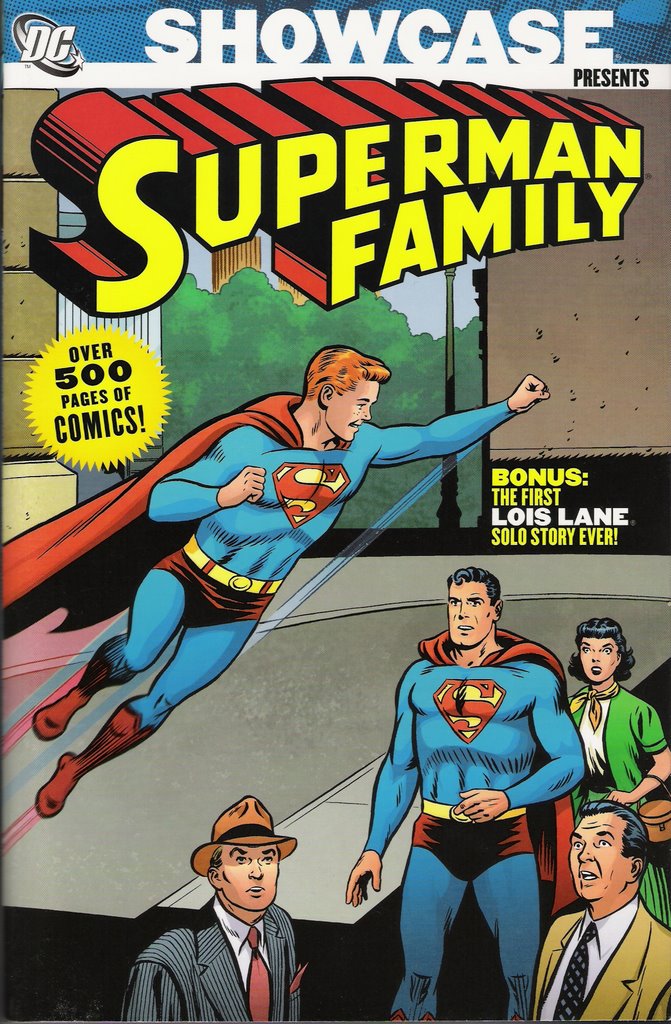
Showcase Presents: Superman Family

Yes, once upon a time comic books were so popular with children (as opposed to weird adults) that not only did Superman have two series (Action Comics & Superman), but even his supporting cast members like Jimmy Olsen and Lois Lane could support their own series. Showcase Presents: Superman Family vol. 1 celebrates those halcyon days of comics publication. Like other titles in the Showcase Presents series, Superman Family reprints five hundred pages of DC Silver Age adventures. Superman Family essentially contains the first twenty-two issues of Superman’s Pal, Jimmy Olsen, but because it includes Lois Lane’s first solo story it had to be renamed. Presumably future volumes will not only contain stories from the pages of Jimmy Olsen, but will also publish reprints of Superman’s Girl-Friend: Lois Lane, a title that premiered later.
The inclusion of the Lois Lane material can only be a good thing, as I really dig the I Love Lucky romantic comedy zaniness of the early issues and find the “feminism” of the later issues to be curiously entertaining if not inspiring. The inclusion of the Lois Lane material will also probably improve the overall quality of the volume, because the Jimmy Olsen issues tend to be less successful than what I read in Showcase Presents: Superman.
While the Superman material tends to be formulaic, the stories do tend to show more cleverness and play within that formula than those in Jimmy Olsen. While I like Jimmy Olsen in theory because he’s the most any of us can be by being a friend of the gods, in practice reading about the friend of the gods can get quite boring. In general, Jimmy discovers the plan of some local mobster who must, as union rules dictate, have some moniker like “Lucky” or “Legs” in quotes. Jimmy tries to solve the crime or get the scoop on his own or because he wants to help Superman, but inevitably gets into trouble and either has to have Superman help him secretly or has to ask for help directly by using his signal watch. I’m about half way done with the volume now and it only seems to be getting more and more formulaic. Although to be fair, it might only seem that way because the formula becomes more and more apparent as I read on.
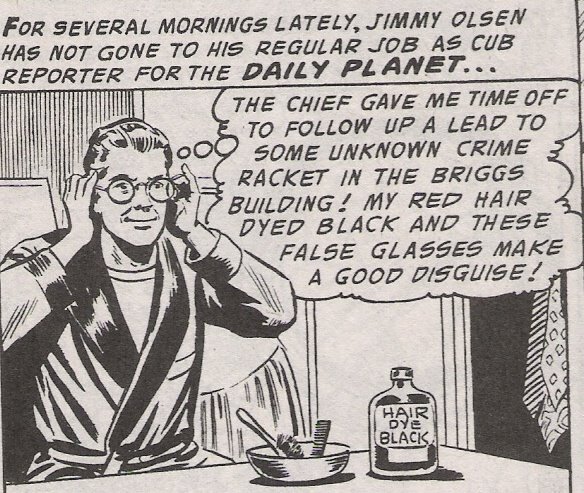
However, there isone issue that isjust simply so great that I have to praise it. Usually, there is nothing more boring than having a comic book story (or fan) explain how a generic convention is actually possible. The issue of Jimmy Olsen that I adore naturalizes the convention that glasses are an adequate disguise without such an explanation. In the issue Jimmy Olsen notices “Loot” Logan (see I’m not lying about the “names”) and other criminals are going to the Briggs Building. Jimmy decides that he will disguise himself as Dick Hunter, Elevator Boy and get the scoop. Unfortunately, Jimmy gets an accidental knock to his noggin and as what tends to happen when one gets hit in the head, suffers amnesia. Jimmy, still in disguise, mistakes himself as Dick Hunter and goes about his day. At one point he sees an advertisement for The Daily Planet that informs readers that Jimmy Olsen is on staff and is Superman’s Pal. Jimmy, as Dick Hunter, envies Jimmy Olsen’s relationship with Superman not realizing that he really is Superman’s most special buddy. Perfect!! Jimmy, even as Dick, is still Jimmy and so he manages to stumble upon the criminals’ scheme (they’re running a crime school), gets in trouble, and after being told by the criminals that he is Jimmy Olsen, has to signal Superman for help.
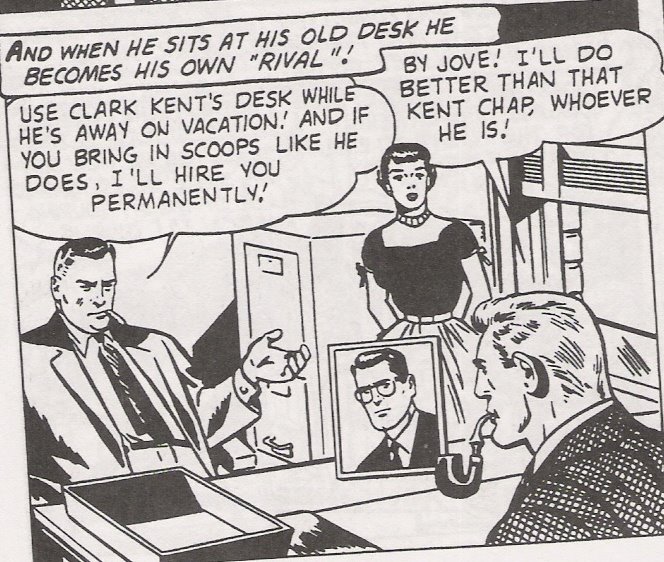
Even though I have some affection for the story, it too proves to be formulaic. Not only that, it’s also pilfered from another Superman comic. In Showcase Presents: Superman vol. 1 my favorite story was one where Superman gets amnesia and disguises himself as Englishman Clarence Kelvin. Kelvin takes a temporary job at The Daily Planet, filling in for Clark Kent while heis on vacation. Starring at a photo of Clark Kent on his desk (why Clark keeps a headshot of himself on his desk is beyond me), Superman does not recognize himself. Olsen’s plot reenacts the entire device, only without the clever twist. At the end of the Sueprman story, Lois feels gratified that she’s finally figured out that Superman is really Clarence Kelvin. Superman, realizing that he has nothing to fear, merely shreds the disguise and says that Lois has got him, but now she’ll have to try and figure out his new identity. In contrast, Jimmy gets knocked on the head again, regaining his memories as Olsen, but cannot remember the adventure he has just had as Dick Hunter. While the last panel does produce pathos, it’s just not as clever.
Thursday, June 29, 2006
Superman Returns

It probably will not come as a surprise that I saw Superman Returns on opening day. While there are numerous filmic arguments that I would like to make (first among them is how the film is a literal re-scripting of the first film from 1978), none of them seem intellectually honest at the moment. For what has always brought me to Superman has been my heart.
Because of this, I will tell everyone my favorite part of the movie and why it is scenes like this that draw me to the Man of Steel and to the superhero genre in general. Early in the film, we see Superman sitting on Martha Kent's couch in Smallville watching television. He has been away for five years, exploring space and as such has lost touch with the events of Earth. Watching TV, he flicks through news report after news report. The expression on his face says it all. When Superman watches tragedy after tragedy on the news he does not see it as we see it and Brandon Routh does an excellent job of conveying this fact. For when I watch the news and hear of tragedy or hardship I either watch passively, viewing the event as something very removed from my life, or watch it sadly, knowing that there is not much that I can do to ameliorate the situation. When Superman watches the news, a flash of anger crosses his face but it is tempered with determination. For Superman knows that he is capable of leaping tall buildings in a single bound, that he is faster than a speeding bullet, and that he is more powerful than a locomotive. In short, Superman knows that he can do something about it.
A scene like this is also in a film of a much lower caliber, Teenage Mutant Turtles. In that film the vigilante Casey Jones (for those of you who don’t remember (and consider yourself lucky) Jones is a cross between Travis Bickle and Jason), watches the news and decides that he will fight crime. But Jones watches the news differently than Superman. Jones watches the news like it is particularly violent pornography and it cannot help but to inspire him to commit equally violent actions. Jones wants to hurt the people he's feed up with. It's not about decency; it's all about revenge and violence. However, what makes me like Superman more than all other superheroes is that Superman stands for as Perry White says in this film, "Truth, Justice, and the rest of it." Superman fights the good fight not because he’s driven by revenge or because he wants fame or power, but because he can; and because he can, he knows that he must. What always remains inspiring to me about Superman is not that it makes you want to believe for a second that a man can fly but that he is intrinsically good. And I've never found a good reason for turning away from the intrinsically good, no matter how cornball it may seem.