Showing posts with label Superman. Show all posts
Showing posts with label Superman. Show all posts
Friday, May 2, 2008
On the Latest Weekly Comics
cross-posted with Narrative Review
Up above DC Comics Editor-in-Chief Dan Didio discusses with Mike Carlin about the upcoming weekly series Trinity. Written by Kurt Busiek and drawn by Mark Bagley this series will focus on DC Comics's Big Three: Superman, Batman, and Wonder Woman.
Over the past years DC has experimented with the weekly format in both 52 and Countdown to Final Crisis. Although they have been commercially successful, artistically and critically they have been failures. The disappointments of these series have come from the fact that both 52 and Countdown were written not with their own stories in mind, but as an explanation for a story to follow - a prequel before the original as it were. Thus, 52 was meant to set up the One Year Later time line that was already being told in DC's monthly output and Countdown was written to setup this summer's blockbuster miniseries Final Crisis. Unfortunately, 52 was written by a committee of overextended writers and artists and none of the various story-lines running through 52 adequately hung together, nor did it really set up the One Year Later time line effectively until the last two issues. The less said about Countdown the better.
So what can we expect of Trinity? I remain cautiously optimistic. Unlike the other efforts which were produced by multiple over-committed writers and artists, Trinity will at least have the benefit of a unified creative vision in Busiek and Bagley. As far as I know the series does not have to end some place that is mandated by a corporate crossover. Hopefully, this will allow Busiek to tell his own story which will actually have something of a resolution.
While my hopes are considerably higher for Trinity than they ever were for 52 or Countdown, I think that the weekly episodic format might just be too much for comics. Can one story really last a full year and have the necessary stopping points that the weekly format provides? I'm not so sure. Television manages the weekly format, but then again, the over all plotting of a sitcom or a television drama is a) never a full year and b) not usually totally dependent on an overarching plot structure. But who knows? Maybe I'll be surprised?

Friday, September 8, 2006
Showcase Presents: Superman Family
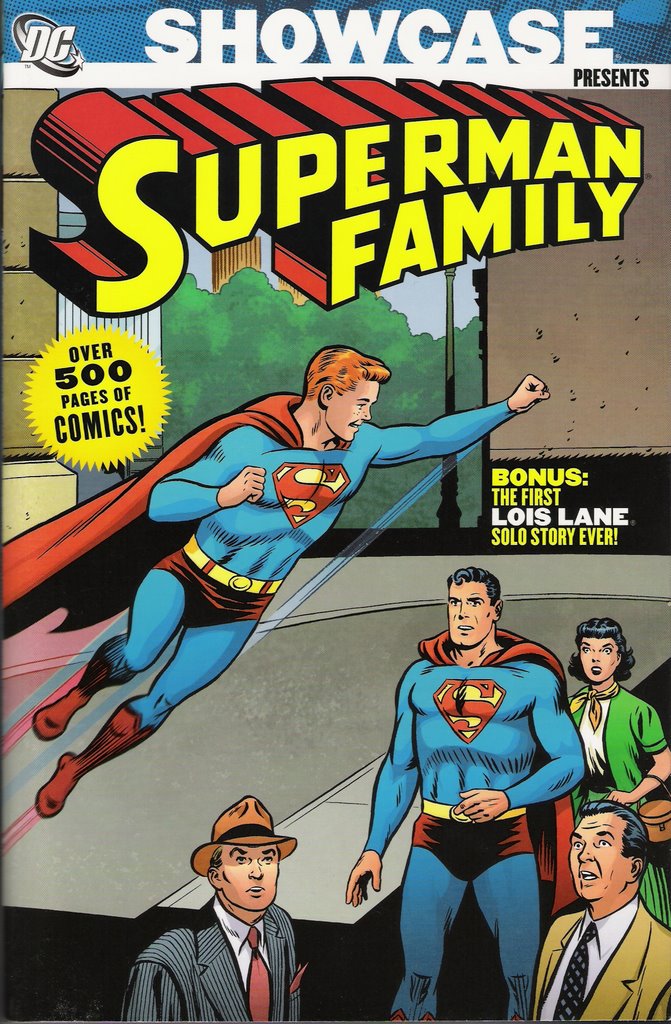
Yes, once upon a time comic books were so popular with children (as opposed to weird adults) that not only did Superman have two series (Action Comics & Superman), but even his supporting cast members like Jimmy Olsen and Lois Lane could support their own series. Showcase Presents: Superman Family vol. 1 celebrates those halcyon days of comics publication. Like other titles in the Showcase Presents series, Superman Family reprints five hundred pages of DC Silver Age adventures. Superman Family essentially contains the first twenty-two issues of Superman’s Pal, Jimmy Olsen, but because it includes Lois Lane’s first solo story it had to be renamed. Presumably future volumes will not only contain stories from the pages of Jimmy Olsen, but will also publish reprints of Superman’s Girl-Friend: Lois Lane, a title that premiered later.
The inclusion of the Lois Lane material can only be a good thing, as I really dig the I Love Lucky romantic comedy zaniness of the early issues and find the “feminism” of the later issues to be curiously entertaining if not inspiring. The inclusion of the Lois Lane material will also probably improve the overall quality of the volume, because the Jimmy Olsen issues tend to be less successful than what I read in Showcase Presents: Superman.
While the Superman material tends to be formulaic, the stories do tend to show more cleverness and play within that formula than those in Jimmy Olsen. While I like Jimmy Olsen in theory because he’s the most any of us can be by being a friend of the gods, in practice reading about the friend of the gods can get quite boring. In general, Jimmy discovers the plan of some local mobster who must, as union rules dictate, have some moniker like “Lucky” or “Legs” in quotes. Jimmy tries to solve the crime or get the scoop on his own or because he wants to help Superman, but inevitably gets into trouble and either has to have Superman help him secretly or has to ask for help directly by using his signal watch. I’m about half way done with the volume now and it only seems to be getting more and more formulaic. Although to be fair, it might only seem that way because the formula becomes more and more apparent as I read on.
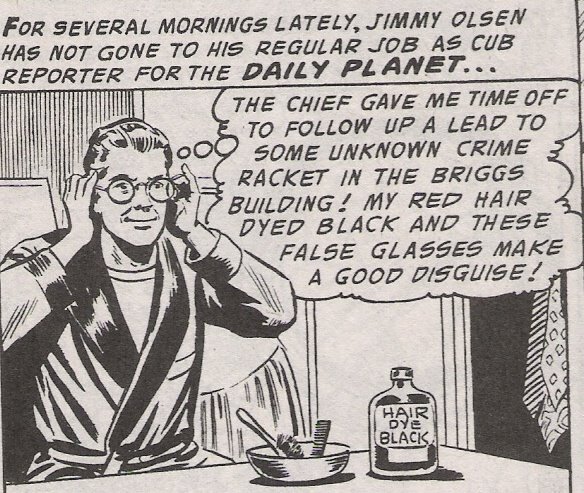 However, there isone issue that isjust simply so great that I have to praise it. Usually, there is nothing more boring than having a comic book story (or fan) explain how a generic convention is actually possible. The issue of Jimmy Olsen that I adore naturalizes the convention that glasses are an adequate disguise without such an explanation. In the issue Jimmy Olsen notices “Loot” Logan (see I’m not lying about the “names”) and other criminals are going to the Briggs Building. Jimmy decides that he will disguise himself as Dick Hunter, Elevator Boy and get the scoop. Unfortunately, Jimmy gets an accidental knock to his noggin and as what tends to happen when one gets hit in the head, suffers amnesia. Jimmy, still in disguise, mistakes himself as Dick Hunter and goes about his day. At one point he sees an advertisement for The Daily Planet that informs readers that Jimmy Olsen is on staff and is Superman’s Pal. Jimmy, as Dick Hunter, envies Jimmy Olsen’s relationship with Superman not realizing that he really is Superman’s most special buddy. Perfect!! Jimmy, even as Dick, is still Jimmy and so he manages to stumble upon the criminals’ scheme (they’re running a crime school), gets in trouble, and after being told by the criminals that he is Jimmy Olsen, has to signal Superman for help.
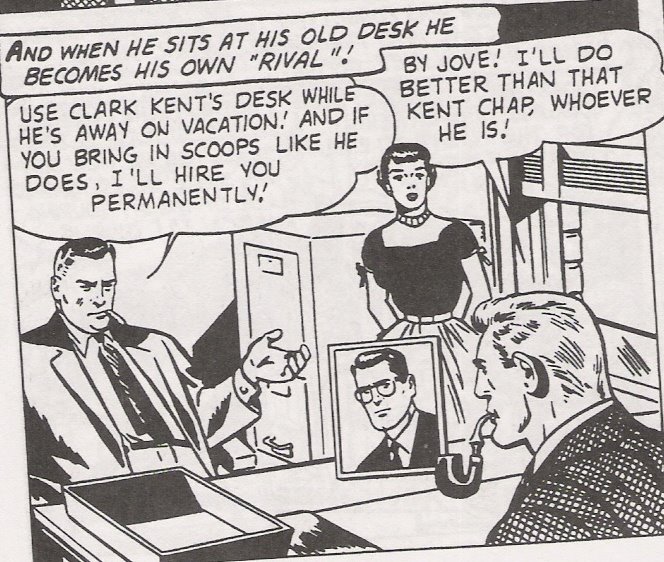 Even though I have some affection for the story, it too proves to be formulaic. Not only that, it’s also pilfered from another Superman comic. In Showcase Presents: Superman vol. 1 my favorite story was one where Superman gets amnesia and disguises himself as Englishman Clarence Kelvin. Kelvin takes a temporary job at The Daily Planet, filling in for Clark Kent while heis on vacation. Starring at a photo of Clark Kent on his desk (why Clark keeps a headshot of himself on his desk is beyond me), Superman does not recognize himself. Olsen’s plot reenacts the entire device, only without the clever twist. At the end of the Sueprman story, Lois feels gratified that she’s finally figured out that Superman is really Clarence Kelvin. Superman, realizing that he has nothing to fear, merely shreds the disguise and says that Lois has got him, but now she’ll have to try and figure out his new identity. In contrast, Jimmy gets knocked on the head again, regaining his memories as Olsen, but cannot remember the adventure he has just had as Dick Hunter. While the last panel does produce pathos, it’s just not as clever.
Thursday, June 29, 2006
Superman Returns

It probably will not come as a surprise that I saw Superman Returns on opening day. While there are numerous filmic arguments that I would like to make (first among them is how the film is a literal re-scripting of the first film from 1978), none of them seem intellectually honest at the moment. For what has always brought me to Superman has been my heart.
Because of this, I will tell everyone my favorite part of the movie and why it is scenes like this that draw me to the Man of Steel and to the superhero genre in general. Early in the film, we see Superman sitting on Martha Kent's couch in Smallville watching television. He has been away for five years, exploring space and as such has lost touch with the events of Earth. Watching TV, he flicks through news report after news report. The expression on his face says it all. When Superman watches tragedy after tragedy on the news he does not see it as we see it and Brandon Routh does an excellent job of conveying this fact. For when I watch the news and hear of tragedy or hardship I either watch passively, viewing the event as something very removed from my life, or watch it sadly, knowing that there is not much that I can do to ameliorate the situation. When Superman watches the news, a flash of anger crosses his face but it is tempered with determination. For Superman knows that he is capable of leaping tall buildings in a single bound, that he is faster than a speeding bullet, and that he is more powerful than a locomotive. In short, Superman knows that he can do something about it.
A scene like this is also in a film of a much lower caliber, Teenage Mutant Turtles. In that film the vigilante Casey Jones (for those of you who don’t remember (and consider yourself lucky) Jones is a cross between Travis Bickle and Jason), watches the news and decides that he will fight crime. But Jones watches the news differently than Superman. Jones watches the news like it is particularly violent pornography and it cannot help but to inspire him to commit equally violent actions. Jones wants to hurt the people he's feed up with. It's not about decency; it's all about revenge and violence. However, what makes me like Superman more than all other superheroes is that Superman stands for as Perry White says in this film, "Truth, Justice, and the rest of it." Superman fights the good fight not because he’s driven by revenge or because he wants fame or power, but because he can; and because he can, he knows that he must. What always remains inspiring to me about Superman is not that it makes you want to believe for a second that a man can fly but that he is intrinsically good. And I've never found a good reason for turning away from the intrinsically good, no matter how cornball it may seem.
Wednesday, December 28, 2005
Showcase Presents
 When I was a very young child my favorite television show was the Super-Friends.* I'm sure this comes as a shock to many of you. I loved Superman, Wonder Woman, Batman and Robin. My favorite game was to play superheroes, casting myself as Superman and doling out the other parts as a sign of ranked friendship. While I've outgrown sucking my thumb and having accidents, I have not outgrown superheroes or comics. My fascination with both message and medium will either lead to my destruction, as a stack of bagged and board comics will invariably topple over and crush my vulnerable skull, or it might lead to some form of marginal academic success. At least, maybe an article in The Journal of Popular Culture or MELUS.
  However, before I go on about possible future additions to my CV or my broken skull, let me talk a little bit more about The Super-Friends.** When my parents got cable in my early teens, besides being taken by Comedy Central and MTV, I was enthralled by The Cartoon Network. They aired reruns of The Super-Friends and although I watched them religiously during the summer, I was really taken aback by just how incredibly lame they seemed. It wasn't like I remembered it at all. Compared to the comics there was hardly any story. Compared to the Paul Dini animated Batman and Superman cartoons there was hardly any violence. It wasn't that I wanted a bloodbath, but I was expecting a little bit of punching at the very least. Even the animated credits of the Adam West Batman show had punching. "What's the point of having super strength when you never use it?" I mused. Superman & Co. never really fought anyone. Instead of using direct physical force against the Legion of Doom,*** they always ended up fighting jungle animals. Correction: They ended up fighting robots that looked like tigers. At the time, I was a teenage know-it-all and I interpreted the lack of violence as the interference of some well meaning but misguided parents group. While the show did not encourage children to hit each other, it did encourage animal cruelty, or at least cruelty towards machines that looked suspiciously like regular-old animals.
Having transformed from a teenage know-it-all to an undergraduate pedant, to hopefully something a little more humble, a little more intelligent, I have come to understand that with age comes knowledge, but more importantly the wisdom that as you learn, you understand just how much you don't know. Making this point ever apparent to me is the arrival of DC's Showcase Presents titles. Collecting over 500 pages of material (or about two years worth of comics), these inexpensive reprints provide a glimpse of what comics were really like in the late 1950s and early 1960s.
Having just completed the first two collections, Green Lantern vol. 1 and Superman vol. 1, I have to say that neither of these titles provide the violence that I so wanted to see in junior high. While this supposed lack was probably due to the power of the official censoring board of the industry, The Comics Code Authority, I can't say that the stories are really harmed by the lack of physical encounters. Instead of dwelling on Superman's invulnerability and strength, the stories collected in Showcase Presents: Superman understand the appeal of the Superman character is not that he's strong per se, but that his strength may give out. What makes these stories successful is that they understand that the true themes of Superman are impotence and insecurity.
 One story that illustrates this perfectly involves Superman developing a new superpower, a miniature double of himself that has all of the Man of Steel's regular superpowers, while leaving Superman himself normal. Superman becomes so jealous of his doll-sized helper that he anguishes, "Everyone's impressed. . . except me! Don't they understand how I feel playing second fiddle to a miniature duplicate of myself. . . a sort of super-imp?" Indeed, Superman's jealousy is so intense that when the little imp sacrifices himself to save Superman, the Man of Tomorrow cannot even muster the super-empathy to feel sad for his dead partner. As the miniature doppelganger fades from existence, Superman thinks to himself, "I wonder. . . did it have a life of its own which it sacrificed for me, or was it just carrying out my thoughts. . . before I could put them into words? I . . . I'll never know!" That's the best Superman can muster: "I wonder if somebody died for me. Oh well, best not to think about it."
 It is the funnier, crazier, and wackier stories that work best in both collections. My favorite of the Green Lantern anthology uses the conventions of the Lois Lane/Clark Kent/Superman romance. Green Lantern's brother Jim is being pursued romantically by a reporter who is wrongly convinced that Jim is really Green Lantern. Of course she can't prove it, but whenever she's around Jim, he disappears (usually knocked out by a mobster) and all of a sudden Green Lantern shows up. While the super-imp issue is near and dear to my heart, my favorite of the Superman collection would have to be the issue where Superman gets amnesia and cannot remember that he is Clark Kent and so masquerades as an Englishman named Clarence Kelvin. What is great about this conceit is that Kelvin decides to work for The Daily Planet. Superman's disguises are so convincing that none of them recognize him as either Clark of Superman. Even better, Superman can't recognize himself as Kent even after seeing a picture of himself in his Kent disguise. This is perfect.
While these editions are printed on less expensive paper and in black and white, the amount of material reproduced here is well worth the price. These stories are fun to read and are much more affordable than DC's Archives line or trying to hunt down the actual back issues. This is an excellent purchase for anyone wanting to read 1960s comics or who need to do archival work in comics research. This would be me and about ten other folk.
*There really needs to be Super-Friendster. Superheroes need to keep in touch too. I'm sure it's been a long time since Captain Comet got to knock back a few with Bobo the Detective Chip.
** Those feeling like Beatrix at the end of Kill Bill vol. 2 when she screams "How much longer does this last?" when Bill is giving his monologue about Superman are totally in the right at this point.
*** Why is the Right so much better at organizing? The Villains had an entire Legion, a Legion of $%#^in' Doom! The superheroes only had a social hall. They might as well have been Quakers.
* * * * *
Subscribe to:
Posts (Atom)