Friday, February 16, 2007

Portrait of the Comics Reader as a Young-ish Man

1985. My apartment in New York City. A sudden realization, and not a pleasant one. My thirtieth birthday is right around the corner. I’m posted to turn one year older than Batman… I’ve come to accept, in recent years, that Spider-Man is younger than my brother, but Batman? Batman? My favorite childhood hero? The lantern-jawed wise father figure? I’m actually gonna be older than Batman? This was intolerable. Something had to be done.

With these words Frank Miller opens the collected edition of his most memorable contribution to comics, The Dark Knight Returns. The work presents perhaps, the most elegant solution to Miller’s problem. Miller makes Batman older, which in the parlance of graphic novels (née comics) means somewhere around fifty. Thus, we get a Batman, much older than Miller’s thirty, a Batman who worries about his knees when climbing up his bat-rope, who needs Bat-ifocals glasses to ensure that his batarangs hit their targets, and will probably need to go to Bat-cross for his medical needs. However, nothing in comics but the status quo lasts. DKR was only a few issues long and it was not long before Bruce Wayne stopped being a Dirty Old Man and became a dashing millionaire playboy again. The number one rule of comics: you get older, but Bruce Wayne will never collect Social Security.

It was only after college when I had some sense of what Frank Miller was writing about. I found that I could no longer identify with the teen sidekicks. My life had passed them by and unless their emotional plight hit some type of universal cord, I just could not identify with them. Yes, it could be exciting to see Robin fight a Yeti in the rocky mountains of Tibet, but in the end I could not care about his fights with his father or the bad grades he got because he was out fighting crime. Even for comics, it seemed trivial. I had my B.A., was working a crappy administrative job at UCLA, and was hopping that I would get into graduate school so that said job would be over. Robin was fifteen, worrying about getting his driver license, and was hopping the Teen Titans would ask him to join. I was simply too old to be hanging out with the Boy Wonder. I had Big Boy concerns.

But, if comics eventually make you feel old because you outgrow the characters, things get even worse when you realize that your mastery over the storylines has grown out of date. Every 10 years DC Comics does what fans call retconning, meaning that they retroactively change their company wide continuity; they change the narrative past. Small retconning is common place in comics to allow for creative growth, however every ten years it seems DC attempts to do it in a comprehensive way. Since DC Comics overhauled their line last year I’ve found that things I could recall with a frightening level of encyclopedic detail – things such as Superman’s origin story – have been, if not fundamentally altered, significantly tweaked. Now, if you asked me to give you a description of what Krypton was like, I honestly could not tell you with any veracity. This is after a lifetime of reading Superman comics. Things I used to know, I don’t know anymore. What really makes you feel old as a comics is fan is not growing older than the perpetually young heroes of your childhood, but that comics companies force an odd form of senility upon you. It’s nerdy, fictitious Alzheimer’s and I don’t know my way around the House of Mystery.

The cure: read more comics. But with my healthcare, how could I afford it? Anyway, can’t I die with dignity and just read the reprints?

Wednesday, November 1, 2006

Holy Fiction, Batman!


According to scientists, children do believe that Batman thinks Robin is real. At least not at first.

In a recent study, scientists were interested in seeing if children could understand the difference between fictional worlds. While it has long been observed that very young children can tell the difference between reality and fantasy, it was unclear whether or not they could determine the difference between fictional worlds. Thus, children were asked a series of questions that concerned whether one fictional character believed another fictional character to be real. For the most part children agreed that Batman would think Square Bob Sponge Pants, Blue (of Blues Clue fame), and Finding Nemo were fictional creations. However, scientists were baffled when the children answered that Batman thought Robin was fictional. Did children think that Batman lived a very elaborate fantasy life? It turns out the results were anomalous and might stem from children’s inability to see things from Batman’s perspective. Why they can see things from a talking sponge’s perspective and not a grown man is baffling, but whatever. When asked whether or not Batman could “touch Robin” (this just sounds bad) or “talk to Robin” the children agreed that Batman could.

When I was a kid I wouldn’t even play with different lines of action figures. Part of this was no doubt due to the fact that my He-Man and Superman action figures were radically different sizes, but I also remember saying in my child-like squeal to a friend not in the know, “They’re from different universes though. Superman doesn’t even know who He-Man is.” As you might have guessed, I was not very popular.

Saturday, October 21, 2006

A Hobby Sized Hole in My Heart


Although the World Series starts tonight, as far as I’m concerned Major League Baseball is over with until next spring. Even those sentimental Tommy Lasorda commercials, where he encourages disheartened fans to watch baseball despite the fact that their teams didn’t make the postseason, don’t have any effect on me anymore. On Thursday, during game seven of the National League playoff between the St. Louis Cardinals and the New York Mets, the most I could muster is a half-hearted, “I love this game?” It would have made the former manager of the Dodgers and ambassador to baseball cry.

In my defense, I did try to take Lasorda’s words to heart and go along with baseball even after the Dodgers lost all three playoff games to the Mets. After all, as a Dodger fan, how could I turn Tommy down? He’s probably the most visible face of the Dodgers and so, when Lasorda tells me to buck up, I try to do my best. After the Dodgers were eliminated by the Mets, I decided to pick up the pieces, hang up my Dodgers cap, and root for the very team that demolished the boys in blue.

I even developed a couple of reasons for rooting for the Mets, trying to develop some sort of second tier loyalty. First of all, the Mets have three former Dodgers on their roster: second basemen José Valentín, catcher Paul Lo Duca, and right fielder Sean Green who the Mets recently acquired from the Arizona Diamondbacks. I figured that basically, I was just rooting for the Dodgers, circa 1999. And who doesn’t love the Dodgers, circa 1999?

I also figured that the Mets were essentially nothing more than the replacement team for the Dodgers in New York; the Mets were founded after all, only after the Dodgers left New York for Los Angeles. Essentially, this amounts to a snobby kind of fandom where all you’re doing is rooting for the team out of pity. I was OK with this because it took the sting out of them beating the crap out of the Dodgers. The funny thing about this strategy is that you can just as easily see the Mets as the replacement team for the Dodgers’ rivals, the San Francisco Giants, who left New York about the same time that the Dodgers did. Thus, during the game both me and a Giants fan were united against the St. Louis Cardinals.

But the most important reason that I had for rooting for the Mets relied on a kind of cannibal logic. I figured that since the Mets beat the Dodgers, they absorbed their strength. Unfortunately, I guess the Mets really just absorbed the Dodgers ability to lose big games.

Now that the two teams in the World Series are the Detroit Tigers and the St. Louis Cardinals, I really can’t find a team to root for. Sorry Tommy. The reasons for my inability to feel the spirit of baseball are complex. Originally, I thought that the owner of St. Louis Cardinals was racist Marge Schott. You might remember her for praising Hitler’s early rise to power, for owning a swastika arm band, and for calling the African American members on her team racial epithets. But it turns out that she’s dead and owned the Cincinnati Reds. Nonetheless, the association remains. Besides, I’ve never gotten over the fact that, when I was a kid, I went to a Dodger game and one of the Cardinals didn’t drop his bat when he ran to first. Although they beat the Dodgers all the time, I’m still convinced that the Cardinals must not be that good; even an unathletic kid like me knew to drop the bat. As for Detroit, how can I root for a city that gave us Eminem and a state that has, according to the Museum of Tolerance’s map of hate, the most white power groups in the country? Certainly, Detroit has given us some good stuff like the Detroit Cobras, but that’s just a drop in the bucket, and it’s been a long time since Motown released anything as good as the Supremes.

Now, I’m left with a hobby sized hole in my heart. Comics are getting a little bit better since I last posted about them. But it’s still not the same. You still can’t really have a conversation about them and the fans tend to be just as weird as ever. Dodger cap hanging low, I’ll go back to reading comics but I’m not happy about it. Besides, my other hobby, library science only provides so many opportunities for practice. And I've already organized my books from AZ361.S56 1964 to Z253.U69 2003.

Friday, September 8, 2006

Showcase Presents: Superman Family


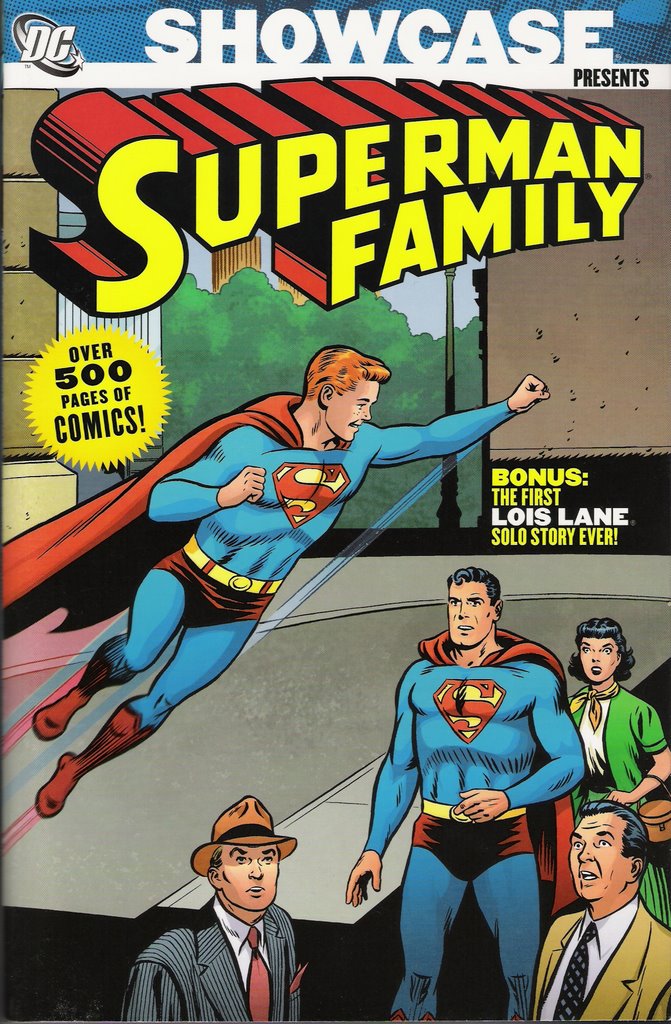
Yes, once upon a time comic books were so popular with children (as opposed to weird adults) that not only did Superman have two series (Action Comics & Superman), but even his supporting cast members like Jimmy Olsen and Lois Lane could support their own series. Showcase Presents: Superman Family vol. 1 celebrates those halcyon days of comics publication. Like other titles in the Showcase Presents series, Superman Family reprints five hundred pages of DC Silver Age adventures. Superman Family essentially contains the first twenty-two issues of Superman’s Pal, Jimmy Olsen, but because it includes Lois Lane’s first solo story it had to be renamed. Presumably future volumes will not only contain stories from the pages of Jimmy Olsen, but will also publish reprints of Superman’s Girl-Friend: Lois Lane, a title that premiered later.

The inclusion of the Lois Lane material can only be a good thing, as I really dig the I Love Lucky romantic comedy zaniness of the early issues and find the “feminism” of the later issues to be curiously entertaining if not inspiring. The inclusion of the Lois Lane material will also probably improve the overall quality of the volume, because the Jimmy Olsen issues tend to be less successful than what I read in Showcase Presents: Superman.

While the Superman material tends to be formulaic, the stories do tend to show more cleverness and play within that formula than those in Jimmy Olsen. While I like Jimmy Olsen in theory because he’s the most any of us can be by being a friend of the gods, in practice reading about the friend of the gods can get quite boring. In general, Jimmy discovers the plan of some local mobster who must, as union rules dictate, have some moniker like “Lucky” or “Legs” in quotes. Jimmy tries to solve the crime or get the scoop on his own or because he wants to help Superman, but inevitably gets into trouble and either has to have Superman help him secretly or has to ask for help directly by using his signal watch. I’m about half way done with the volume now and it only seems to be getting more and more formulaic. Although to be fair, it might only seem that way because the formula becomes more and more apparent as I read on.

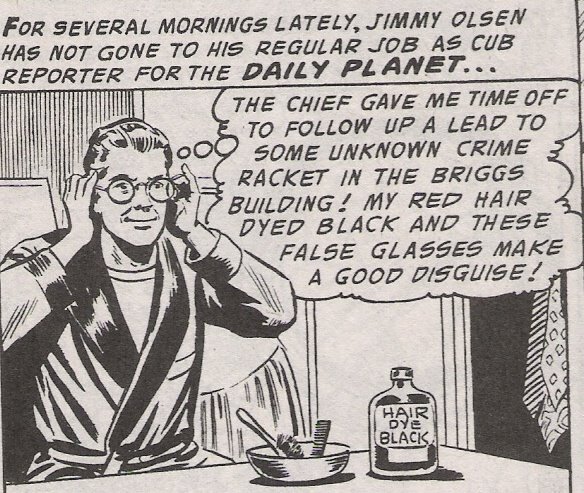
However, there isone issue that isjust simply so great that I have to praise it. Usually, there is nothing more boring than having a comic book story (or fan) explain how a generic convention is actually possible. The issue of Jimmy Olsen that I adore naturalizes the convention that glasses are an adequate disguise without such an explanation. In the issue Jimmy Olsen notices “Loot” Logan (see I’m not lying about the “names”) and other criminals are going to the Briggs Building. Jimmy decides that he will disguise himself as Dick Hunter, Elevator Boy and get the scoop. Unfortunately, Jimmy gets an accidental knock to his noggin and as what tends to happen when one gets hit in the head, suffers amnesia. Jimmy, still in disguise, mistakes himself as Dick Hunter and goes about his day. At one point he sees an advertisement for The Daily Planet that informs readers that Jimmy Olsen is on staff and is Superman’s Pal. Jimmy, as Dick Hunter, envies Jimmy Olsen’s relationship with Superman not realizing that he really is Superman’s most special buddy. Perfect!! Jimmy, even as Dick, is still Jimmy and so he manages to stumble upon the criminals’ scheme (they’re running a crime school), gets in trouble, and after being told by the criminals that he is Jimmy Olsen, has to signal Superman for help.

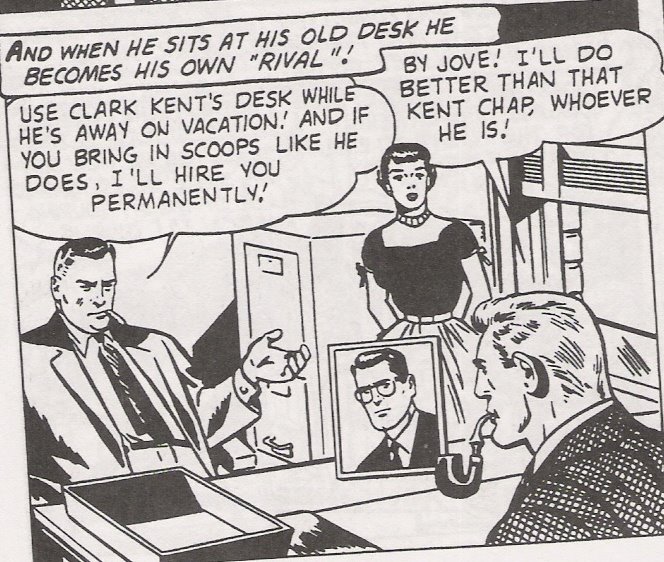
Even though I have some affection for the story, it too proves to be formulaic. Not only that, it’s also pilfered from another Superman comic. In Showcase Presents: Superman vol. 1 my favorite story was one where Superman gets amnesia and disguises himself as Englishman Clarence Kelvin. Kelvin takes a temporary job at The Daily Planet, filling in for Clark Kent while heis on vacation. Starring at a photo of Clark Kent on his desk (why Clark keeps a headshot of himself on his desk is beyond me), Superman does not recognize himself. Olsen’s plot reenacts the entire device, only without the clever twist. At the end of the Sueprman story, Lois feels gratified that she’s finally figured out that Superman is really Clarence Kelvin. Superman, realizing that he has nothing to fear, merely shreds the disguise and says that Lois has got him, but now she’ll have to try and figure out his new identity. In contrast, Jimmy gets knocked on the head again, regaining his memories as Olsen, but cannot remember the adventure he has just had as Dick Hunter. While the last panel does produce pathos, it’s just not as clever.

Future posts if things get better.

Monday, August 7, 2006

Comics vs. Baseball


The past two days have provided me with more reasons why Baseball should be favored over comics, at least seasonally. I saw this morning at
Comic Book Resources pictures from Wizard World Chicago, one of the summer’s big Comics Conventions. The fact that I share an interest with these people is frightening.

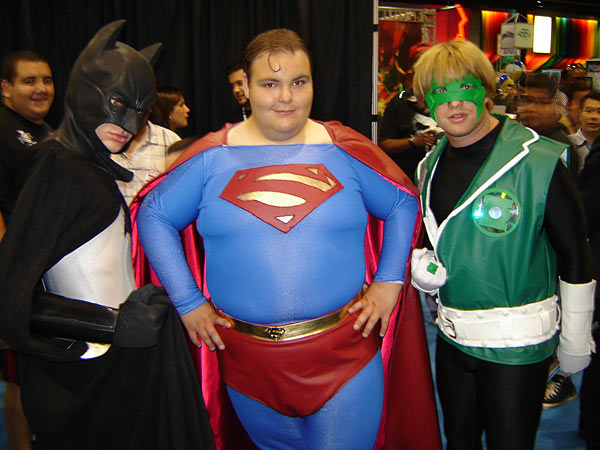
While CBR has plenty of pictures of kids dressed up as their favorite characters, for every picture of a young Captain America beaming because he got to go to a convention in costume, there are more than three dozen like the one above. Here Butterball Superman, 15 year old Batman, and what appears to be Keanu Reeves in a bad wig as Green Lantern, pose for their picture. And while it’s obvious that these three like the attention their receiving from the comics fan press and no doubt their fellow fans at the con, there seems to be to be something unreasonable about a fan that goes to such heights. Where Superman’s smirk betrays a confidence, I’m just a little embarrassed for him by how the costume accentuates his man boobs. Is this just an expression of self-neglect and social stigma turned into a strange expression of prideful abnegation? Really, I think there are better ways to go. Even secret shame seems a more dignified response. Or even making fun of those who clearly have no secret shame.

The more positive aspect to this comparison is that I was recently inspired to work out harder by the Dodgers, thus avoiding a Super-Belly and Super-Heart Disease and Super-Diabetes. I was at the gym the other day and the game happened to be on. It was the top of the sixth, and the Dodgers were loosing to the Marlins, one to three. I planned on a fifty minute run and intended to leave when my time was up. But as I was running the Dodgers began to turn the tide, mostly due to the ineptitude of the Marlins’ pitching staff, which walked in three runs. By the end of the seventh inning The Dodgers were up four runs and I was nearly done with my run. Not only did I want to see the end of the game – another post-trade Dodgers victory – but it dawned on me that in running, I was in fact being more athletic than any of the ball players out on the field that day. While certainly they could all outrun me, out hit me, and out field me, a lot of the time they were just standing around waiting for a hit. By running at a constant rate, I was in fact getting more of a work out than they were. When the work out program ended towards the beginning of the eighth I decided to run for the rest of the game, and I ended up running about eight miles for about eighty minutes.

The recruiters should be knocking on my door any day now.

Sunday, July 23, 2006

A Post in Which The Author Comes to Discover Why He Has Become More Interested in Baseball


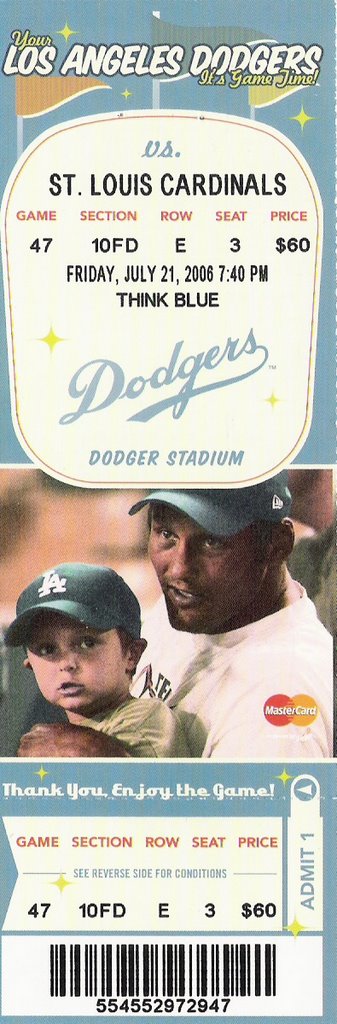
On Friday night I went to see the Dodgers play the St. Louis Cardinals. We had excellent seats – about fifteen rows back from the field just to the right of home plate along the first base line. The Dodgers played well defensively, although I think they should have gotten Brad Penny off of the mound before he gave up a homerun to Chris Duncan. Offensively, they did not do much, only garnering five hits on a full nine innings. And so they lost two – zip at the end of the game. Given the Dodgers run of losses and bad luck to injuries it was more than likely that they were going to lose and I knew that going into the game. However, I suppose part of me will always suspect that the Dodgers should win against the Cardinals because the earliest baseball game I can remember seeing was a match up between the two teams and I can still distinctly remember one of the Cardinals running with the bat. Part of me still believes that the Cardinals must still, even though it’s been probably more than twelve years, really suck. I mean c’mon, even at eight I knew to drop the frickin’ bat

But despite my innate knowledge of just how bad Cardinals must at least secretly stink, the Dodgers offensive performance was disappointing. In the second half of the first inning Jeff Supan of the Cardinals struck the Dodgers’s big stick, J. D. Drew in the knee with a wild pitch taking him out for the rest of the game. I haven’t heard much about his recovery, only that the injury is not expect to be too serious. My new baseball hero, Nomar Garciaparra didn’t get much time to shine as he has in the other games I’ve seen this season. With three AB’s he popped it up to right field in the first, got thrown out later in the game, and was later walked.

But enough about the game itself. I noticed I’m more into baseball this season. Part of the attraction no doubt stems from the fact that I got last seasons EA MLB video game for my Game Cube. I’ve learned a lot more about the game – stuff that I probably should have learned growing up because I’m male and American. The other factor in my growing interest in Dodgers baseball is my hatred of Orange County and my proximity to the Angels, who I’ve always kind of suspected as being the WASP-Country Club team of Southern California. But I think my growing interest in Dodgers baseball has really lied in my decreasing interest in the comics that are being produced these days. Despite some of my posts, the stuff being put out by DC Comics (my company of choice) has just been boring and total dreck, and for the first time in many years I’m no longer a Wednesday buyer. Instead, I got a few subscriptions and when I’m in L.A. I’ll occasionally go to the shop and pick up something that I can’t get through the mail. Since something has to fill the “hobby hole” in my life, and its summer, baseball seems like a good substitution. It has some similarities, in that both possess a lore of trivia and have distinctive personalities and allow you to have irrational favorites. The upside of liking baseball in comparison to comics is that less people will begin to snore when you want to talk about it. Plus, baseball fans are not, on average, as scary as comics fans.

Anyone want to go to a game this season?

Thursday, June 29, 2006

Superman Returns


It probably will not come as a surprise that I saw Superman Returns on opening day. While there are numerous filmic arguments that I would like to make (first among them is how the film is a literal re-scripting of the first film from 1978), none of them seem intellectually honest at the moment. For what has always brought me to Superman has been my heart.

Because of this, I will tell everyone my favorite part of the movie and why it is scenes like this that draw me to the Man of Steel and to the superhero genre in general. Early in the film, we see Superman sitting on Martha Kent's couch in Smallville watching television. He has been away for five years, exploring space and as such has lost touch with the events of Earth. Watching TV, he flicks through news report after news report. The expression on his face says it all. When Superman watches tragedy after tragedy on the news he does not see it as we see it and Brandon Routh does an excellent job of conveying this fact. For when I watch the news and hear of tragedy or hardship I either watch passively, viewing the event as something very removed from my life, or watch it sadly, knowing that there is not much that I can do to ameliorate the situation. When Superman watches the news, a flash of anger crosses his face but it is tempered with determination. For Superman knows that he is capable of leaping tall buildings in a single bound, that he is faster than a speeding bullet, and that he is more powerful than a locomotive. In short, Superman knows that he can do something about it.

A scene like this is also in a film of a much lower caliber, Teenage Mutant Turtles. In that film the vigilante Casey Jones (for those of you who don’t remember (and consider yourself lucky) Jones is a cross between Travis Bickle and Jason), watches the news and decides that he will fight crime. But Jones watches the news differently than Superman. Jones watches the news like it is particularly violent pornography and it cannot help but to inspire him to commit equally violent actions. Jones wants to hurt the people he's feed up with. It's not about decency; it's all about revenge and violence. However, what makes me like Superman more than all other superheroes is that Superman stands for as Perry White says in this film, "Truth, Justice, and the rest of it." Superman fights the good fight not because he’s driven by revenge or because he wants fame or power, but because he can; and because he can, he knows that he must. What always remains inspiring to me about Superman is not that it makes you want to believe for a second that a man can fly but that he is intrinsically good. And I've never found a good reason for turning away from the intrinsically good, no matter how cornball it may seem.